Seven climate disclosures from the first mandatory cycle of IFRS S2 based reporting, downloaded, read in full, and recorded against eight disclosure dimensions. Every count on this page traces to a page number in a published document.
What this is
- Desk research on public filings. None of these companies used our product, our diagnostic, or spoke to us.
- Nothing here scores, ranks or grades a company. It records what each disclosure contains and what it does not.
- Where a report is ambiguous it is recorded as ambiguous, not resolved by inference.
- The full working table is published as a CSV so any cell can be checked against the source.
Scope and method
We looked for reports filed under the first mandatory cycle of ISSB based climate reporting and read the ones we could source. Six are Malaysian issuers in the National Sustainability Reporting Framework Group 1 cohort, all with calendar year ends. One is Australian, in the AASB S2 Group 1 cohort, for the year ended 31 December 2025.
Each report was searched for the language of eight disclosure dimensions, and every candidate passage was then read in context before anything was recorded. That second step is not a formality. An early keyword pass on financial effects returned zero matches across all seven reports, while the underlying phrase was present in six of them. No count on this page is derived from a match count. Each cell was adjudicated by reading the passage at the page cited.
Two candidate reports were dropped. Both had 30 June 2025 year ends, which precede first application of their respective regimes, and neither contained any reference to IFRS S2, AASB S2 or the NSRF. They are pre-regime reports, not weak ones, and counting them would have misrepresented both the companies and the cycle.
Where the standard asks for a number, the sample answers
The most mechanically checkable item in the review is the Scope 2 method, which has one unambiguous factual answer. All seven state one. Four disclose both location-based and market-based figures. Two state location-based only and give a reason: Sunway explains that heating and cooling are excluded because they are not purchased, and Tenaga Nasional states the approach covers core operations within Peninsular Malaysia, citing IFRS S2.29(a)(i)(1-2), B30 beside the method itself.
The comparable item that asks for reasoning rather than a value is the basis on which the time horizons were set. Three of seven state one. Sunway's horizons “align with the timelines used for strategic decision-making”. Tenaga Nasional's align “with the timelines used for strategic green decision-making”. Rio Tinto's short-term timeframe “aligns with our annual planning process and is informed by market analysis”.
This is the clearest split in the review, and it holds within the same reports. The value is present far more often than the reasoning behind it.
Six reports define time horizons. No two definitions match
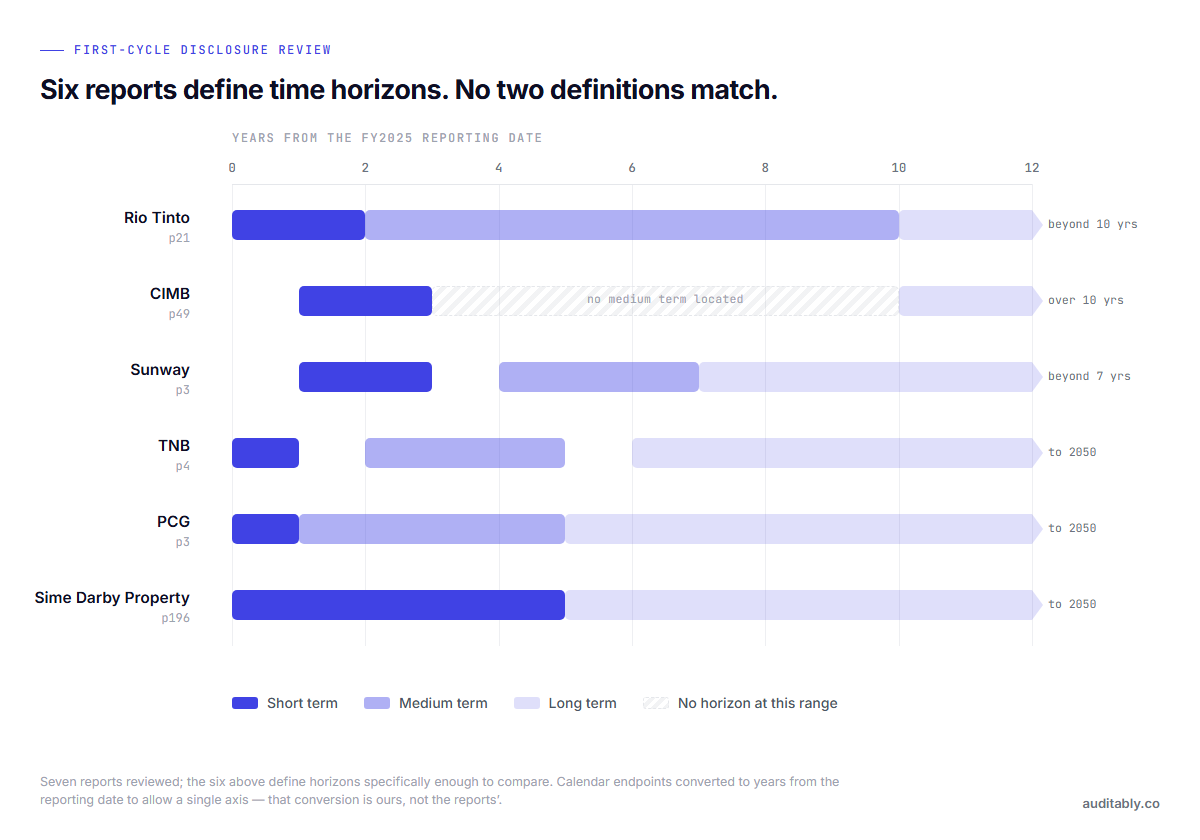
“Long term” runs from beyond seven years to 2050. “Short term” runs from up to two years, to one to three years, to a single named year. Two reports use a medium term of four to seven years and two to ten years respectively, ranges that overlap but do not match. Sime Darby Property is the only report to explain an absent horizon, stating that a medium term “is not applied, as relevant considerations are addressed within the long-term horizon”.
None of this is non-compliance. The standard does not prescribe where the boundaries fall, and each of these definitions is defensible on its own terms. The observable consequence is narrower and more practical: horizon-tagged disclosures in this sample are not directly comparable with each other, and a reader cannot assume that “long term” carries the same meaning from one report to the next.
No report quantifies anticipated financial effects in the climate disclosure
Five of the seven address the requirement. Of those five, three explain why quantitative information is not provided, one gives qualitative effects by horizon, and one cross-references the financial statements. Two are ambiguous: no passage quantifying or explaining an absence was located in either.
The explanations are specific rather than boilerplate. Sime Darby Property states that “quantitative financial effects have not been disclosed at the reporting date, as the necessary methodologies, assumptions and data inputs required to reliably estimate these effects… are still being developed”. Maybank states that it has not provided quantitative estimates and gives its reasoning. Sunway invokes the IFRS S1 paragraphs 38 to 39 exemption and supplies the paragraph 40(a) explanation.
Stated precisely, and not beyond the sample: in the seven reports reviewed, no quantified estimate of anticipated financial effects appears within the climate disclosure itself. Rio Tinto is the only one to point into the accounts, cross-referencing pages 161 to 164 of its annual report for current financial impacts. Those pages fall outside the 34-page climate extract we obtained, so their content was not verified here.
Where the standard supplies a way to say “not yet”, the sample uses it
Five of seven claim transition reliefs. One cites the relief to paragraph level: Sime Darby Property names “the climate-first relief under IFRS S1 paragraph E5”. Two do not claim transition reliefs. Sunway has no relief claim located, though it does invoke the separate quantification exemption. Rio Tinto has no AASB S2 transition relief located; it describes an ASIC relief, but that governs which entity the report covers and is a different instrument.
Taken with the previous section, the pattern is consistent. The parts of the standard that supply a defined mechanism for disclosing an absence are the parts this sample executes most completely. Saying “not yet, and here is why” is a well-formed disclosure, and most of these reports make it.
One structural note worth separating out. Sunway's paragraph 40(a) explanation, the reason quantitative information was not provided, is given inside the IFRS S1 and S2 content index rather than the narrative body. The required explanation exists. Where it physically sits differs from the other reports that gave one.
Assurance is where the sample diverges most
Four positions appear across seven reports, all within a single reporting cycle, and all consistent with their respective regimes.
- Reasonable assurance on Scope 1 and 2, in one report. Rio Tinto states that in 2025 KPMG provided limited assurance over progress reporting against its Climate Action Plan “in addition to its reasonable assurance of our Scope 1 and 2 emissions, and limited assurance of Scope 3 emissions”. The Scope 3 work is scoped to four named categories.
- External limited assurance, in four reports. Maybank states the scope covers FY2025 emissions “including Scope 1, Scope 2 and selected Scope 3”. Sime Darby Property names all three elements: limited assurance, PricewaterhouseCoopers PLT, and ISAE 3000 (Revised).
- Internal review only, in one report. Tenaga Nasional states that its Sustainability Statement “was subjected to internal review by the Group Internal Audit Department”, scoped to two entities, and covering the “adequacy and effectiveness of controls underpinning the data collection processes” for Scope 1 and Scope 2. The Bursa prescribed table records no external assurance against the indicator rows.
- Level not determinable, in one report. CIMB states that selected indicators were independently assured by PwC Malaysia in accordance with ISAE 3000. The words “limited assurance” and “reasonable assurance” appear nowhere in its 171 pages, and the pages carrying the assurance statement contain no extractable text, so we could not determine the level from the document.
The point is the spread, not a ranking. A reader moving between two reports in this sample may be reading figures that carry materially different levels of external scrutiny, and in one case a level the document does not state.
The full table
Eight dimensions across seven reports, 56 cells. Each carries a page reference in the CSV. Determinations are: Disclosed, the report contains the item; Partial, present but incomplete; Ambiguous, present but the document does not resolve the question; and Not located, which means targeted searching did not find it, never that it is absent.
Scroll the table sideways to see every report →
| Dimension | CIMB | Maybank | PETRONAS Chemicals | Sime Darby Property | Sunway | Tenaga Nasional | Rio Tinto |
|---|---|---|---|---|---|---|---|
| Transition reliefs claimed | Disclosed | Disclosed | Disclosed | Disclosed | Not located | Disclosed | Not located |
| Time horizons quantified | Partial | Ambiguous | Partial | Disclosed | Disclosed | Disclosed | Disclosed |
| Scenario analysis - scenarios named | Disclosed | Disclosed | Disclosed | Partial | Partial | Disclosed | Disclosed |
| Financial effects | Ambiguous | Disclosed | Disclosed | Disclosed | Disclosed | Ambiguous | Disclosed |
| Scope 2 method | Disclosed | Disclosed | Disclosed | Partial | Disclosed | Disclosed | Disclosed |
| Industry-based guidance considered | Disclosed | Disclosed | Disclosed | Not located | Disclosed | Disclosed | Not located |
| Emissions target base year | Disclosed | Ambiguous | Disclosed | Disclosed | Ambiguous | Disclosed | Partial |
| Assurance level / provider / standard | Ambiguous | Disclosed | Disclosed | Disclosed | Disclosed | Disclosed | Disclosed |
Download the analysis table (CSV) Download the review (PDF)
Both are free and ungated. No email, no signup.
On the gap between what is disclosed and what is evidenceable
This needs stating carefully, because the limit is real and it is easy to overreach here.
We reviewed published documents. We did not see any working papers, and nothing here speaks to whether any disclosure is supportable. A report that states less may be fully evidenced internally. A report that states more may not be. Nothing in this review can distinguish those two cases, and no reader should infer otherwise from anything above.
What the documents do show is a difference in what has been committed to in writing. When a report states that its horizons align with its planning cycle, or that its base year was recalculated, or that a control over a data collection process was reviewed, it has made a specific assertion that could later be tested against internal records. Where a disclosure states a value without the reasoning behind it, there is no equivalent assertion on the page to test. That is an observation about documents, not a conclusion about anyone's controls.
Limitations
- Seven reports is not a statistical sample. No finding here generalises beyond these seven documents.
- Six of seven are Malaysian. This largely describes one regime's first cycle.
- Findings rest on extractable text. Image-based content is invisible to the method, which is why one assurance level is recorded as undetermined rather than absent.
- The Rio Tinto document is a 34-page climate extract, not the full annual report. Every “not located” for that report means “not in the extract”.
- Two pillars are not covered. The eight dimensions span strategy, metrics and targets, assurance and transition reliefs. Governance and risk management are not in this table.
- These are first-year disclosures under a phased regime that explicitly permits reliefs. Comparison against a later cycle is not yet available.
Sources
Every document below was downloaded and read in full. Links are to the filed PDFs.
- CIMB Group Holdings Berhad — Sustainability Report 2025, 171 pages. Malaysia. Source document (PDF)
- Malayan Banking Berhad (Maybank) — Sustainability and Environmental Report 2025, 278 pages. Malaysia. Source document (PDF)
- PETRONAS Chemicals Group Berhad — Integrated Report 2025, 99 pages. Malaysia. Source document (PDF)
- Sime Darby Property Berhad — Integrated Annual Report 2025, 447 pages. Malaysia. Source document (PDF)
- Sunway Berhad — Sustainability Report 2025, 223 pages. Malaysia. Source document (PDF)
- Tenaga Nasional Berhad — Sustainability Statement 2025, 165 pages. Malaysia. Source document (PDF)
- Rio Tinto — Annual Report 2025, climate extract, 34 pages. Australia. Source document (PDF)
Dropped from the sample: Wesfarmers Limited (Annual Report 2025) and YTL Corporation Berhad (Annual Report 2025). Both have 30 June 2025 year ends preceding first application of their regimes, and neither references IFRS S2, AASB S2 or the NSRF. Reasons are recorded in the sources file, which also carries the retrieval date and document title for every report above.
How to cite this page
If you use the table, please link to this page rather than reproducing it, so readers reach the page references and the limitations with it.