In this guide
Decide what the measurement includes
Write the scope at the top of the log: kitchen or site, dates, service periods, included material and measurement method. Distinguish preparation waste, spoilage, unserved prepared food and plate returns when those categories are useful for your operation.
Choose a consistent treatment for edible and inedible material. Record destinations separately, such as a waste collection stream or another managed route. Do not combine redistributed food with discarded food without explaining the chosen measurement framework.
The US EPA's wasted-food assessment resources include a snapshot-assessment guide and a tracking log. They are useful primary references when establishing a measurement approach. Your ongoing log should state whether it represents continuous measurement or a sample of services.
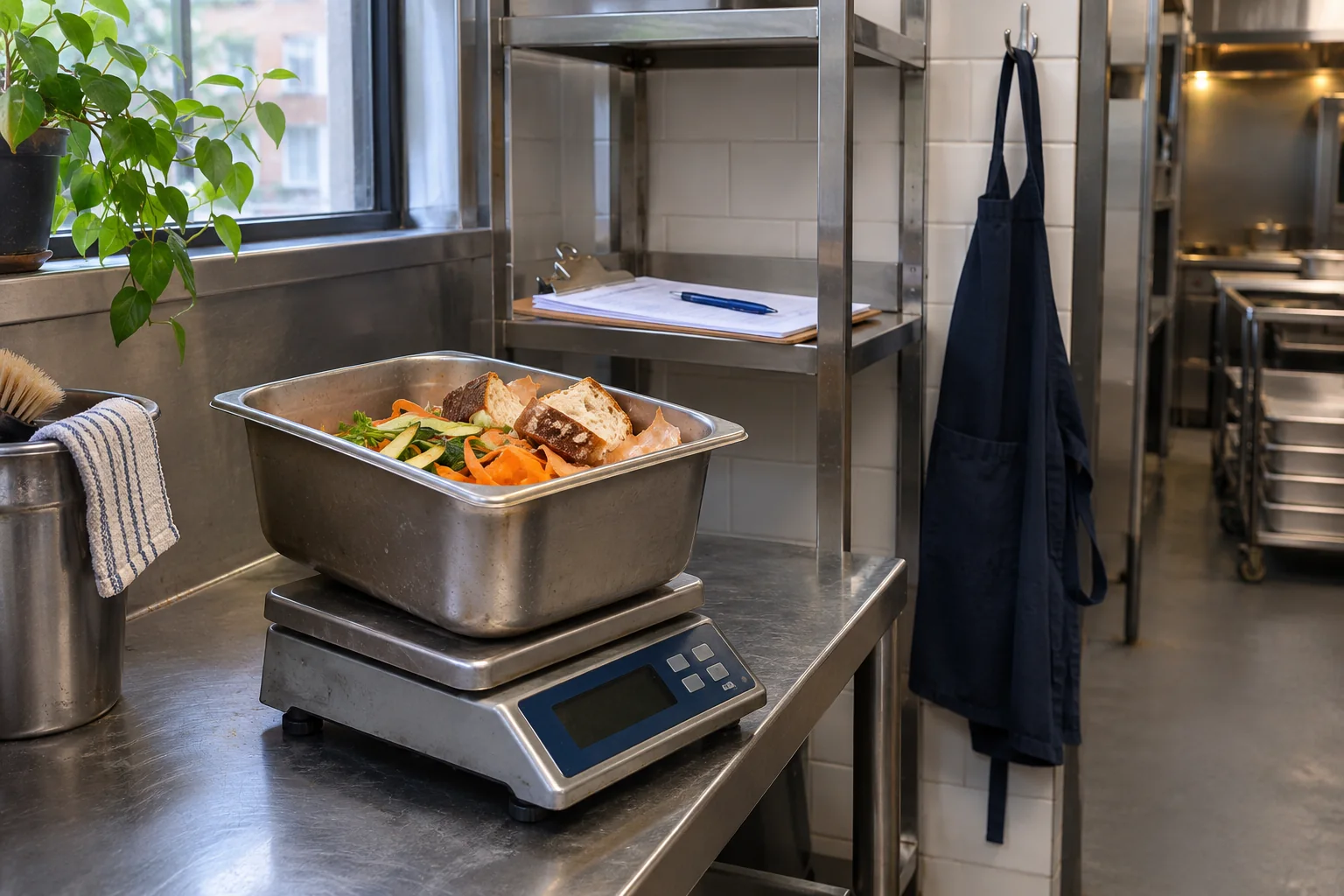
Weigh the material, not the container
For a weighing-based record:
Net food weight = gross container-and-food weight − empty container tare.
A fictional container weighs 2.0 kg empty and 14.5 kg after collection. The net recorded food weight is 12.5 kg. Keep the scale unit and container identity visible. If containers differ, one generic tare may produce incorrect results.
Record estimated quantities separately from weighed quantities. Avoid converting portions or volume into kilograms with an unexplained constant. If an estimate is necessary, preserve its method, assumptions and limitations.
Track the cause while the event is still understandable
| Stage | Useful question | Example record |
|---|---|---|
| Storage | Was the item damaged, expired or unsuitable for use? | Product, quantity, date and stock reference |
| Preparation | Was the waste an expected by-product or a process issue? | Food category, station and preparation activity |
| Service | Was more food prepared than served? | Service period, item and unserved quantity |
| Plate returns | What returned from customers? | Category and measurement method, without personal details |
These are investigation categories, not a performance score for individual staff. Avoid drawing conclusions from one unusually busy or disrupted service. Review patterns with the kitchen team and preserve the context.
Worked example: kilograms per cover
Suppose a fictional kitchen records 40 kg of food waste and 200 covers during the same measured services. Its measured intensity is 40 ÷ 200 = 0.20 kg per cover.
If the next measured period has 45 kg and 300 covers, the ratio is 0.15 kg per cover. Absolute waste rose by 5 kg while the ratio fell. Report both measures so the activity denominator does not obscure the total.
Try the calculation
The starting numbers are fictional. Use matching periods, units and boundaries.
A simple arithmetic check. It does not validate your source records or method.
The cover count must match the measured waste period. Combining a one-day waste sample with a week's covers understates the result. If the kitchen serves mixed activities, explain which covers are included and whether that denominator is appropriate.
Give the log a simple review routine
At the end of each measured service, check unit, tare, net weight, stage and missing entries. At the end of the review period, compare the source logs with the summary and record any exclusions.
The New York State Pollution Prevention Institute's food-service self-assessment resources provide additional measurement and analysis aids. Use an approach suited to the operation rather than assuming a small sample describes an entire year.
Retain the original entries when correcting a total. Record the changed value, reason and supporting note. A reviewer should be able to distinguish a genuine operational change from a corrected tare or missing service.
Questions you might have
Can I use the log to calculate carbon emissions?
Not on its own. A carbon calculation needs an applicable method, material and destination information, and suitable factors. Kilograms of food waste are not kilograms of CO2e. Keep any later calculation separate and traceable.
Should I put food cost in the same record?
You can add a clearly defined cost measure, but distinguish purchase cost, preparation cost and menu selling price. Multiplying waste weight by a mixed menu price does not establish the financial loss.
What should be done with the measured food?
Follow the operation's established food-safety and waste-handling procedures. This measurement guide does not determine whether food is safe to serve, donate or reuse.
If a prepared environmental figure later supports a climate disclosure, the evidence-trail guide explains how to retain its source and review record. Auditably is not a kitchen waste-management system.
Prepared with AI assistance using the linked sources and original fictional examples. No customer results, field measurements or independent specialist review are claimed.