Start with the activity, geography, period, unit and calculation boundary you need to represent. Then choose a factor source. A result labelled “electricity factor” can be unsuitable if it covers a different region or includes a different set of emissions.
This directory points to six published sources. It does not reproduce their factor values or certify their suitability for your report. The free selection record helps you document the choice and retain the reference a reviewer needs.
In this guide
- Six sources to investigate
- 1. UK government conversion factors
- 2. US EPA GHG Emission Factors Hub
- 3. US EPA eGRID
- 4. Australian National Greenhouse Accounts factors
- 5. IPCC Emission Factor Database
- 6. GHG Protocol cross-sector resources
- Work through the selection in a fixed order
- A fictional electricity example
- Preserve access and usage conditions
Preview the actual workbook
Fictional entries from the downloadable file. Open the image full-size to inspect the wide table.

Six sources to investigate
| Source | Useful starting point | Main selection question |
|---|---|---|
| UK government conversion factors | Company-reporting factors with annual releases | Does the selected worksheet and factor boundary match the activity? |
| US EPA GHG Emission Factors Hub | Default factors for organisational inventories | Is the factor suitable for the geography, activity and inventory method? |
| US EPA eGRID | US electricity generation and emissions data | Which dataset year, subregion and rate are appropriate? |
| Australian National Greenhouse Accounts factors | Australian emissions-estimation methods and factors | Is this the right source for your reporting purpose? |
| IPCC Emission Factor Database | Searchable factors and supporting references | Does the underlying reference fit this application? |
| GHG Protocol cross-sector resources | Tools and references across several emission sources | Which tool, method and source version are you actually using? |
1. UK government conversion factors
The UK government collection provides annual releases for company reporting. Open the release documentation as well as the spreadsheet. Record the exact factor category, units and year instead of citing only “DEFRA”.
Check whether the chosen entry represents direct activity emissions, an electricity measure or additional supply-chain components. Similar-looking rows can answer different questions. Retain the relevant methodology reference with your selection.
2. US EPA GHG Emission Factors Hub
The EPA hub provides a consolidated source of default factors used in organisational inventories. Check the dataset itself for the version, units and covered activities.
The date a web page was updated is not necessarily the year represented by every factor. Record the dataset release and the underlying data year where supplied. Do not silently relabel an older factor as current-year measured data.
3. US EPA eGRID
eGRID contains information about US electricity generation and associated emissions. Its tables and technical resources help users understand the geographic and methodological distinctions.
For an electricity calculation, keep the selected subregion, rate, unit and dataset year in your working. Do not assume that any US-wide average is suitable for every site, or that a grid-average rate answers every market-based accounting question.
4. Australian National Greenhouse Accounts factors
The 2026 National Greenhouse Accounts factors provide Australian factors and methods for emissions estimates. The publisher explicitly distinguishes this resource from the requirements for reporting under Australia's NGER legislation.
That distinction matters: a convenient public workbook should not be described as universally sufficient for a statutory filing. Follow the method required for your reporting purpose and retain the source used.
5. IPCC Emission Factor Database
The IPCC EFDB is a searchable collection with supporting references. Its own guidance places responsibility for appropriate application on the user and encourages checking the underlying technical reference.
Record the entry identifier and background source. A database search match is the start of selection, not proof that the factor represents your equipment, fuel or operating conditions.
6. GHG Protocol cross-sector resources
The GHG Protocol tools and guidance include resources for stationary combustion, transport and other activities. They are a collection of tools rather than one universal factor table.
Identify the specific tool and guidance document used. Follow its instructions and verify the factor vintage. A calculation may require several tools to cover the inventory boundary.
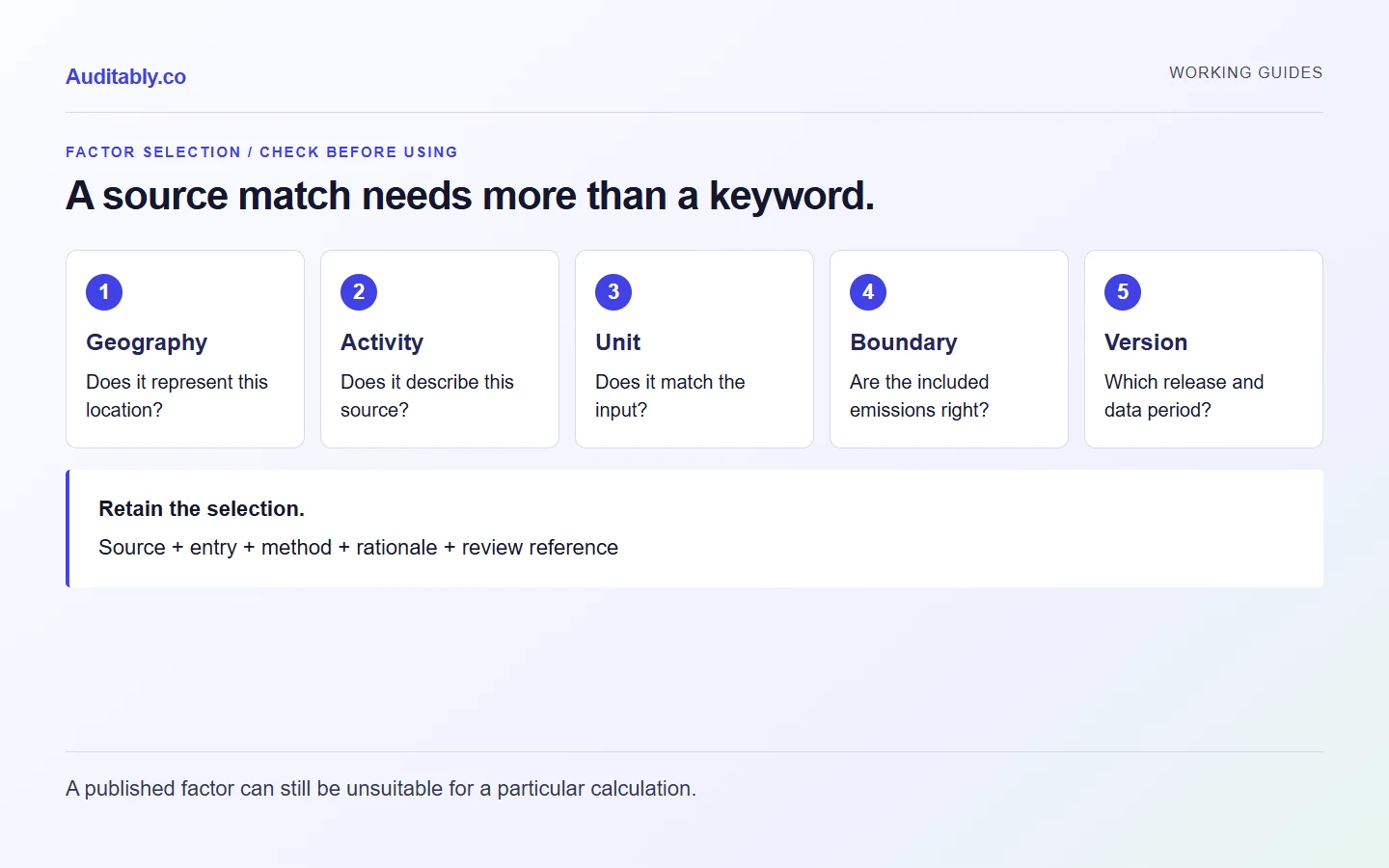
Work through the selection in a fixed order
| Check | Example question | What to retain |
|---|---|---|
| Geography | Does this represent the site's electricity system or fuel market? | Region and selection rationale |
| Activity | Is the record purchased electricity, fuel burned or transport distance? | Activity definition and source record |
| Unit | Do kWh, litres, tonnes or currency units match? | Unit conversion working where needed |
| Boundary | Which gases and lifecycle components are included? | Method and boundary explanation |
| Time | What release and underlying period does the factor represent? | Version, dataset year and access date |
| Review | Who checked the choice and any limitations? | Decision reference and outstanding questions |
A fictional electricity example
A team has a September electricity bill for a US warehouse. Before multiplying usage by a factor, it identifies the site, the relevant accounting method and the geographic basis. It then records the selected dataset, rate, units and source reference. If the factor uses a different unit from the bill, the conversion stays visible in the working.
No numerical factor is supplied here because selecting one requires those facts. The Excel record provides fields for the factor you have selected, its unit, the reason for using it and the review reference. It does not automatically approve the selection or calculate emissions.
Preserve access and usage conditions
Keep a link to the publisher and enough detail to find the exact entry again. Check access, licence and redistribution conditions before copying a dataset into a public tool. Public access does not by itself establish unrestricted republication rights.
For the reporting-method discussion, read emission factors and GWP under IFRS S2. For electricity-method differences, use the Scope 2 guide. This directory serves the narrower task of finding and documenting the source.
Prepared with AI assistance using the linked sources and original worked examples. Illustrative records are fictional. No customer results, independent specialist review or hands-on software testing are claimed.