Somebody asks which global warming potential values you used. You know the emissions number to two decimal places. You are considerably less sure about that, and it is the question with the documentary answer.
Key points
- Measurement follows the GHG Protocol Corporate Standard unless your jurisdiction requires otherwise.
- Conversion uses 100-year GWP values from the latest IPCC assessment available at your reporting date.
- December 2025 added jurisdictional relief on both, so what you used is now a disclosable choice rather than a given.
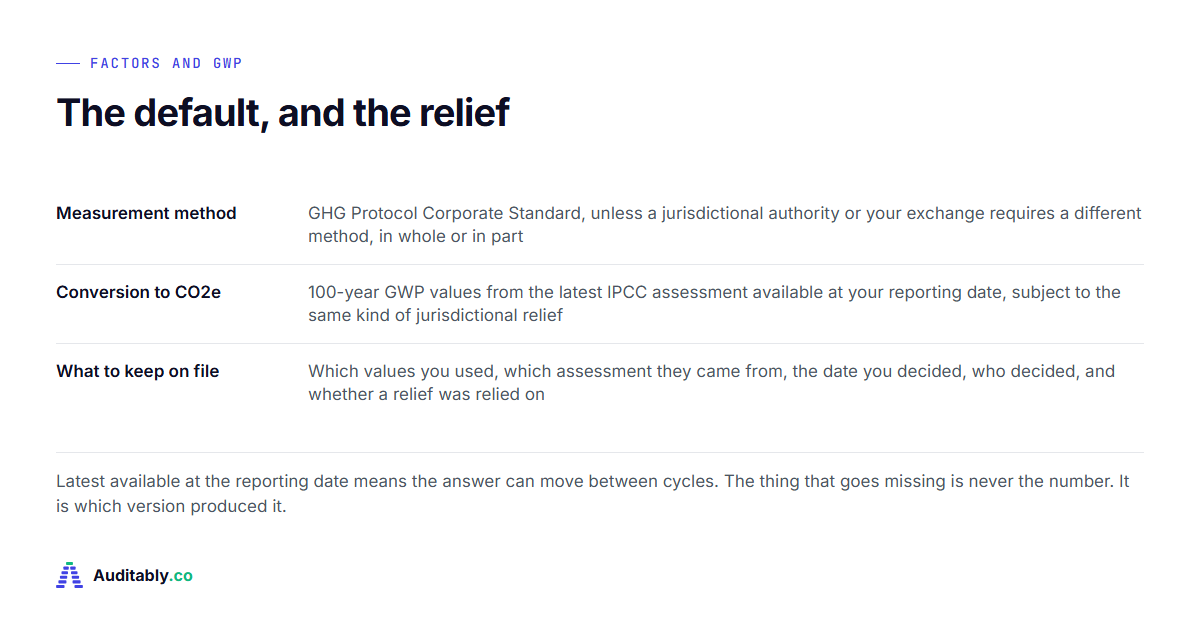
The two defaults
Scroll the table sideways on a phone →
| Requirement | The default |
|---|---|
| Measurement method | The Greenhouse Gas Protocol Corporate Accounting and Reporting Standard. |
| Conversion to CO2 equivalent | Global warming potential values on a 100-year time horizon, from the latest IPCC assessment available at your reporting date. |
Both now carry a jurisdictional relief. Where a jurisdictional authority or the exchange you are listed on requires a different measurement method, in whole or in part, you use that. Where one requires different GWP values, you may use those instead. The December 2025 amendments clarified the first and introduced the second, effective for annual reporting periods beginning on or after 1 January 2027, with early application permitted.
Why latest available at the reporting date does real work
That phrase means your answer can move between cycles without anything changing in your operations.
IPCC assessments update the warming potential of individual gases as the science develops. Methane is the one that moves most visibly. If a new assessment lands between your reporting dates, next year converts on different values from this year, your CO2 equivalent total shifts, and the trend your board reads changes for a reason that has nothing to do with anything you did.
Which is manageable, and only if you can say which values you used and when you switched. That is a one-line record and it is the single most common gap in a first-cycle factor file.
Choosing a factor set
IFRS S2 does not publish emission factors. It points you to the GHG Protocol for measurement and leaves the factor source to you, which means the choice itself becomes a disclosure and a judgement.
Most reporters use a national dataset for their own operations, because grid intensity is inherently local, and a recognised commercial or public dataset for Scope 3. Both are defensible. What is not defensible is a factor whose source nobody can name.
- The dataset and the publisher
- The version or publication year, as well as the dataset name
- The date you adopted it
- The geography and the period each factor is valid for
- The mapping between your activity data and the factor you applied to it
- Who approved the choice
The mapping line is the one that takes work. For Scope 3 Category 1 in particular, most first cycles apply spend-based factors across an expense extract, and the interesting question is not the total but how each expense category was matched to a factor.
When a factor changes mid-cycle
Factor sets get republished, sometimes with restatements of prior years. Two decisions follow and both should be written down.
First, whether you apply the new factor to the current year only or restate the comparative. Either can be right. What matters is that the same choice is applied consistently and disclosed.
Second, whether the change is significant enough that a reader would misread the trend without knowing. A year-on-year movement driven by a factor update rather than an operational change is exactly the kind of thing that should be explained in the narrative rather than left for somebody to notice.
Choosing a factor set, worked through
A group with operations in two countries and a spend-based Scope 3 calculation. Three decisions, each of which becomes a disclosure.
Scroll the table sideways on a phone →
| Decision | What was chosen | Why it was recorded |
|---|---|---|
| Grid factors for Scope 2 | The national published dataset for each country, current version at the reporting date | Grid intensity is inherently local, and the version moves annually |
| Fuel factors for Scope 1 | The same national dataset, for consistency with Scope 2 | Using one source across scopes removes a question about comparability |
| Spend factors for Scope 3 Category 1 | A recognised published set, applied through a documented mapping from expense categories | The mapping carries the judgement, so it is the thing that gets reviewed |
None of those choices is uniquely correct and all three are defensible. What would not be defensible is a factor whose source nobody can name, which is the actual failure mode rather than choosing the wrong dataset.
When the factor changes, and what to do about it
Factor sets are republished, often annually, and sometimes with restatements of prior years. Two decisions follow and both should be written down before the numbers are produced rather than after.
The first is whether you apply the new factor to the current year only or restate the comparative as well. Either can be right. Applying it forward only keeps each year on the basis that was current at the time. Restating keeps the series comparable. What matters is choosing one, applying it consistently, and saying which you chose.
The second is whether the change moves your total enough that a reader would misread the trend without knowing. A year-on-year movement driven by a factor update rather than an operational change is precisely the kind of thing that belongs in the narrative. Leaving it for somebody to discover is how a straightforward technical update turns into a credibility question.
The seven gases, and why the conversion matters
Emissions are reported as a single CO2 equivalent figure, which means seven different gases are being collapsed into one number using a conversion factor per gas.
Those factors are not stable across IPCC assessments. Methane is the one that moves most visibly, and for any business with significant methane emissions, agriculture, waste, oil and gas, a change in the assessment can move the headline total noticeably without a single operational change.
Which is the practical reason the version matters more than the number. If you can state which assessment you converted on and when you switched, a movement in your total is explainable in one sentence. If you cannot, it is an unexplained variance in a reported figure, and that is a different conversation.
What a reviewer asks about factors
- Which factor set did you use, and which version
- Where did you get it, and when did you adopt it
- Which GWP values did you convert on, and from which IPCC assessment
- Did you rely on a jurisdictional relief for either, and which
- How did you map your activity data to the factors
- Did anything change during the period, and how did you handle the comparative
Six questions, all answerable from a one-page factor register. The register is the deliverable, and it is usually the thing that does not exist.
What to keep on file
Independent of which defaults or reliefs apply to you, the same short list answers every question you are likely to be asked.
- Which measurement method you applied, and whether a jurisdictional requirement drove it
- Which GWP values you used, and which IPCC assessment they came from
- The date you decided each, and who decided
- Whether you relied on a jurisdictional relief, and which
- The factor set, its version, and the mapping to your activity data
- Any mid-cycle change, with what it was before and why it moved
The thing that goes missing is never the number. It is which version produced it, and when that was decided.
Common questions
What emission factors does IFRS S2 require?
IFRS S2 does not publish a factor set. It requires measurement in accordance with the GHG Protocol Corporate Accounting and Reporting Standard, unless a jurisdictional authority or your exchange requires a different method in whole or in part. The choice of factor source is yours, and the version you used is what you need to be able to state.
Which GWP values should I use?
Values on a 100-year time horizon from the latest IPCC assessment available at your reporting date. Since the December 2025 amendments, where a jurisdictional authority or your exchange requires different values, you may use those instead.
What happens when the IPCC publishes a new assessment?
Your conversion basis changes for the following reporting date, because the requirement points to the latest assessment available at that date. Your CO2 equivalent totals will move as a result, independently of anything operational. Record which values you used in each period so the movement can be explained.
Do I need to restate prior years when a factor changes?
The standard does not prescribe a single answer. What matters is that you apply one approach consistently and disclose it, and that a reader can tell whether a year-on-year movement came from the business or from the factor.