If your report contains a 2030 emissions target, count how many of the eight required elements sit beside it. Most first-cycle reports carry three or four, which is why the target section is so often the part sent back.
Key points
- Paragraph 33 sets out eight elements for each target, whether you set it yourself or are required to meet it by law.
- Further paragraphs add how the target is set and reviewed, performance against it, and extra items for emissions targets specifically.
- The elements that get skipped are the ones nobody was asked to write down when the target was approved.
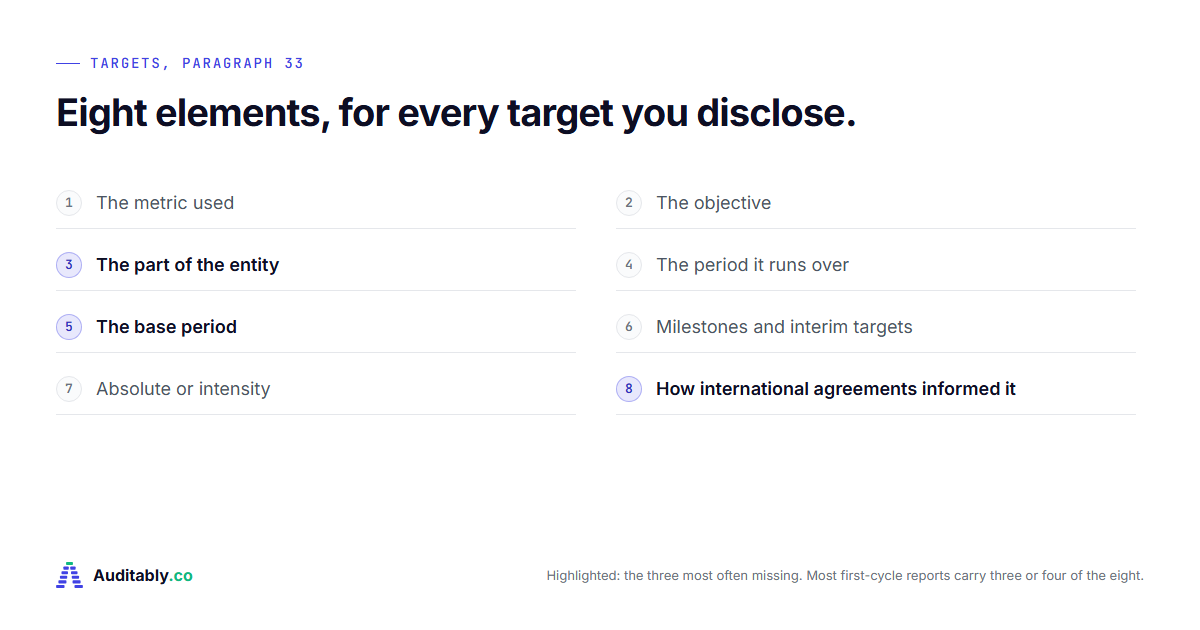
The eight elements
Scroll the table sideways on a phone →
| Element | What it means |
|---|---|
| The metric used | What is actually being measured. Absolute tonnes, intensity per unit of output, share of energy from a given source. |
| The objective | Whether the target is mitigation, adaptation, or conformance with a science-based initiative. |
| The part of the entity it applies to | Which operations sit inside the target boundary. Often narrower than the reporting boundary, and the difference needs stating. |
| The period it applies over | Start and end. The end year alone is not enough. |
| The base period | What progress is measured from. A year alone is not enough if the boundary has changed since. |
| Milestones and interim targets | The points you expect to be judged against before the end date. |
| Absolute or intensity | Which of the two the target is expressed as. They behave very differently as the business grows. |
| How international agreements informed it | How the latest international agreement on climate change, and any jurisdictional commitments arising from it, shaped the target. |
Which ones go missing, and why
The metric, the objective and the end date are almost always present. They are the parts that appear in the press release.
The base period is the most common weak spot. It gets stated as a year with no boundary definition, which becomes a problem the moment your reporting boundary changes through an acquisition or a disposal. If the base year figure was calculated on a different footprint from the current year, the comparison is not measuring what it appears to measure, and a recalculation policy is the thing that saves you.
The link to international agreements is the one skipped most often, because nobody was asked to record it in the meeting where the target was approved. It is a two-sentence answer if you capture it at the time and an uncomfortable reconstruction if you do not.
Scope of application runs a close third. A target covering only the domestic operations of a group that reports globally is a perfectly reasonable target and a misleading one if the boundary is not stated.
What the following paragraphs add
Paragraph 33 is not the end of the target requirements. Three further paragraphs follow.
- How the target is set and reviewed, including whether it was validated by a third party, the review process, the monitoring metrics, and any revisions with the reason for them
- Performance against each target, with an analysis of trends or changes
- For greenhouse gas emissions targets specifically, a further set of items including which gases and scopes are covered, whether it is a gross or net target, and whether a sectoral decarbonisation approach was used
- Your planned use of carbon credits, including the third-party scheme and the type of credit
The carbon credit disclosure catches people out. It is not enough to say credits form part of the plan. The scheme and the type are both disclosable, including whether the credits are nature-based or technological and whether they represent removal or emission avoidance.
The revision problem
Targets get revised. Boundaries change, methodologies improve, and a base year figure calculated three years ago may not be the figure you would calculate today.
The standard expects revisions to be disclosed with the reason, which means the useful thing is not the current number but the record of how it moved. When a base year is recalculated, keep the prior value, the new value, the reason, the evidence and the person who approved it. That record costs almost nothing at the moment it happens and is close to impossible to reconstruct afterwards.
A worked target with all eight elements
The same target, written twice. The first is what most first-cycle reports contain. The second carries the eight elements.
A 40% reduction in Scope 1 and 2 emissions by 2030.
Against that, the complete version:
Scroll the table sideways on a phone →
| Element | As disclosed |
|---|---|
| Metric | Absolute gross Scope 1 and Scope 2 emissions, tonnes CO2 equivalent, location-based |
| Objective | Mitigation, aligned with a science-based pathway |
| Part of the entity | All wholly owned operations. Joint ventures are outside the target boundary |
| Period | From the 2023 base period to 31 December 2030 |
| Base period | 2023, recalculated following the 2025 acquisition, with the recalculation policy disclosed |
| Milestones | An interim 20% reduction by 2027 |
| Absolute or intensity | Absolute |
| International agreements | Informed by the Paris Agreement temperature goal and the national commitment arising from it |
The second version is roughly four sentences longer and answers every question the first one raises. Note the base period row in particular: a year plus a recalculation policy, rather than a year on its own.
Absolute and intensity targets behave differently
Element seven looks like a formality and it changes what the target actually commits you to.
Scroll the table sideways on a phone →
| Absolute target | Intensity target |
|---|---|
| Total tonnes must fall | Tonnes per unit of output or revenue must fall |
| Growth makes it harder | Growth can be accommodated while the total still rises |
| Easier for a reader to interpret | Needs the denominator stated, and the denominator can move for reasons unrelated to emissions |
| Cannot be met by divesting alone without disclosure | Can shift with product mix, which is worth explaining if it does |
Neither is better. An intensity target is often the honest choice for a growing business. What matters is that the type is stated, and that if the target is intensity the denominator is defined precisely enough for a reader to reproduce it.
The three mistakes that send a target section back
Scroll the table sideways on a phone →
| The mistake | The fix |
|---|---|
| A base year with no boundary definition | State what the base year figure covered, and your policy for recalculating it when the boundary changes. |
| A target whose scope of application is implied rather than stated | Say which operations are inside it. A domestic-only target in a global group is reasonable and misleading if unstated. |
| No link to international agreements | Capture it in the meeting where the target is approved. Two sentences then, an uncomfortable reconstruction later. |
All three are recording failures rather than analytical ones. In each case the underlying decision was made; nobody was asked to write it down.
Run your own targets against this
Take the target in your last report and mark off which of the eight are actually on the page. If you carry fewer than six, the gap is almost certainly base period definition, scope of application, or the international agreement link.
None of the three requires new analysis. All three require somebody to have written down what was already decided.
Common questions
What does IFRS S2 paragraph 33 require?
Eight elements for each climate-related target you disclose: the metric used, the objective, the part of the entity it applies to, the period it applies over, the base period from which progress is measured, any milestones or interim targets, whether it is absolute or intensity, and how the latest international agreement on climate change informed it. The requirement applies whether you set the target yourself or are required to meet it by law.
Do I have to disclose a climate target under IFRS S2?
The standard requires you to disclose the targets you have set or are required to meet. It does not require you to set one. If you have no target, there is nothing to disclose under paragraph 33, though the surrounding requirements on metrics still apply.
What is a base period and why does it matter?
The point progress is measured from. It matters because a base year figure calculated on a different reporting boundary is not comparable with the current year, and boundaries change through acquisitions and disposals. A stated base period plus a recalculation policy is what makes the comparison meaningful.
Do I have to disclose carbon credits?
If they form part of how you plan to meet a target, yes, including the third-party scheme and the type of credit. Type means whether the credits are nature-based or technological, and whether they represent carbon removal or emission avoidance.