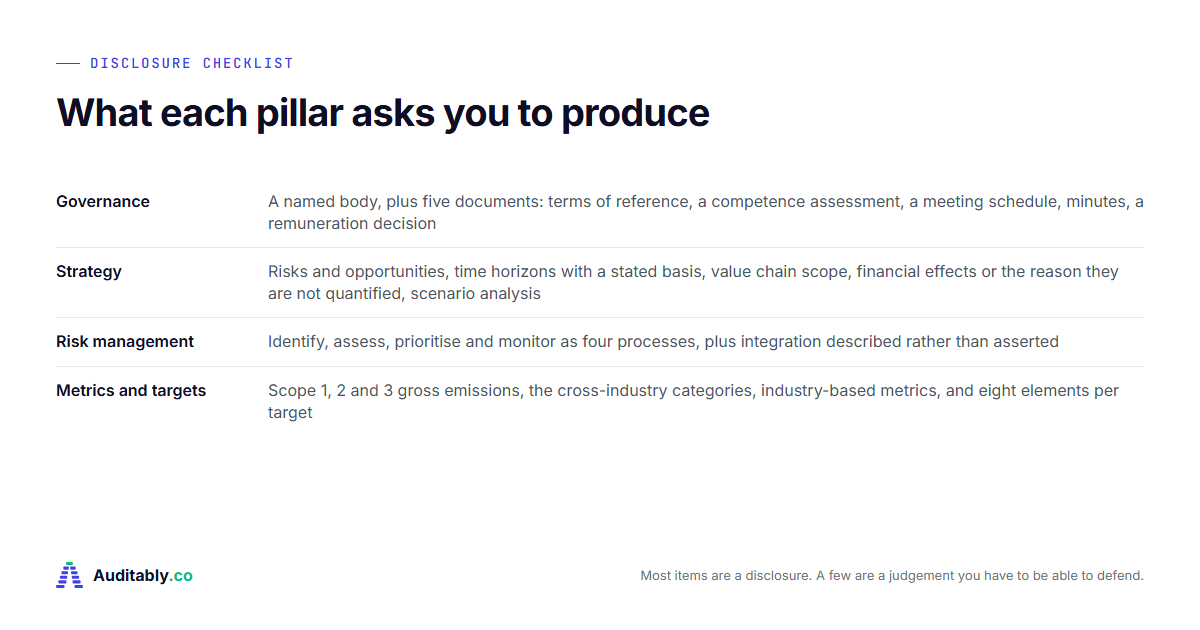
This is the whole of IFRS S2 core content laid out as a checklist, in the order the standard presents it. Each item names the paragraph it comes from and the record you would produce if somebody asked you to support it.
Key points
- Thirty-three paragraphs of core content, paragraph 5 to paragraph 37.
- Strategy is the largest pillar at sixteen paragraphs. Governance and risk management are three each.
- Most items are a disclosure. A smaller number are a judgement you have to be able to defend, and those are the ones that need a contemporaneous record.
How to use this
Run it over your draft rather than your intentions. For each line, ask whether the sentence exists in the report and whether you could produce what sits behind it inside an hour. Items that fail the second test are the ones that turn into findings.
Governance, paragraphs 5 to 7
Paragraph 5 states the objective. Paragraph 6 is the requirement, and it asks you to identify the body or individual responsible for oversight and then answer five specific questions about them.
- A specific body or role is named, rather than a general reference to the board
- Terms of reference, a mandate or a role description that mentions climate is referenced
- How and how often that body is informed is stated
- How the body determined it has the appropriate skills and competencies is described, not asserted
- How climate is taken into account in overseeing strategy and major transactions is described
- Whether climate performance metrics sit in remuneration policies is disclosed either way
- Management role in the same processes is described
Read as a preparer, those five questions are a request for documents. A governance document with climate in it, a record of a conclusion about competence, a meeting schedule, minutes, and a remuneration decision you either made or did not.
Strategy, paragraphs 8 to 23
- Climate risks and opportunities are described, and each is identified as physical or transition
- Time horizons are defined with stated boundaries
- The basis for those horizon boundaries is given, usually the planning cycle the business runs on
- The value chain scope covered by the assessment is described
- Effects on the business model and value chain are disclosed
- Effects on strategy and decision-making are disclosed
- A transition plan is disclosed if you have one, including the assumptions it rests on and how it is resourced
- Current financial effects are quantified, or the reason they are not is explained
- Anticipated financial effects are quantified, or the reason they are not is explained
- Climate resilience is assessed using scenario analysis
- The scenario analysis approach is justified as commensurate with your circumstances
- The inputs, assumptions and timing of that analysis are disclosed
Two of those carry more weight than the rest. The basis for your time horizons, because every risk and every target is tagged against boundaries a reader cannot interpret without it. And the justification for your scenario approach, because paragraph 22 asks for an approach commensurate with your circumstances and that is a judgement somebody will ask you to defend after the person who made it has moved on.
Risk management, paragraphs 24 to 26
- Identify, assess, prioritise and monitor are treated as four distinct processes rather than one sentence
- The inputs and parameters used are described
- Whether and how scenario analysis informs risk identification is stated
- Climate opportunities are covered by the same description
- Integration into overall risk management is described rather than asserted
The last line is where most disclosures stop short. Integrated into our existing risk management processes is a factual claim about something that either happens or does not, and it is one of the easiest sentences in a report to challenge.
Metrics and targets, paragraphs 27 to 37
- Scope 1, Scope 2 and Scope 3 gross emissions are disclosed in tonnes of CO2 equivalent
- Scope 2 is disclosed on a location-based basis, as paragraph 29(a)(v) requires
- Information about contractual instruments is given where it helps a reader understand your Scope 2 position
- The Scope 3 categories included are stated
- The measurement approach, inputs and assumptions are disclosed
- The other cross-industry metric categories are addressed: transition risk, physical risk, opportunities, capital deployment, internal carbon price and remuneration
- Industry-based metrics are referred to and considered, per paragraph 32
- For each target, the eight elements of paragraph 33 are present
- How the target is set and reviewed is disclosed, including any third-party validation
- Performance against each target is disclosed, with an analysis of trends
- For emissions targets, the further required items are disclosed
- Planned use of carbon credits is disclosed, including the scheme and the type
Paragraph 33 is the single most common source of a sent-back target section. It asks for eight things per target: the metric, the objective, the part of the entity it applies to, the period, the base period, any milestones, whether it is absolute or intensity, and how the latest international agreement on climate change informed it. Most first-cycle reports carry three or four of the eight.
Appendix B is part of the standard, not commentary
The core content is thirty-three paragraphs. Appendix B adds a further seventy-three of application guidance, and it carries the same authority. It is not background reading you may consult if you have time.
Scroll the table sideways on a phone →
| Appendix B range | What it supports |
|---|---|
| B1 to B18 | Climate resilience and scenario analysis |
| B19 to B63A | Greenhouse gas emissions, including financed emissions |
| B64 to B65 | The other cross-industry metric categories |
| B66 to B71 | Targets, gross and net, and carbon credits |
Two things follow from that table. Governance and risk management have no application guidance at all, which is part of why they are short. And every Appendix B paragraph supports either strategy or metrics, which is where the drafting effort actually goes.
Paragraph 29 in particular sends you into Appendix B repeatedly. If you are working through the emissions requirements from the core text alone, you are reading roughly half of what applies.
The items that get sent back most often
Across first-cycle reviews the same handful recur, and none of them are measurement problems.
Scroll the table sideways on a phone →
| What gets queried | What it usually means |
|---|---|
| The governance sentence | A named body is missing, or competence is asserted rather than assessed. |
| Time horizons | Boundaries are stated with no basis, so a reader cannot judge whether they match how capital is committed. |
| The target section | Three or four of the eight elements of paragraph 33 are present. Base period, scope of application and the international agreement link are the usual absentees. |
| Scope 3 categories | Included categories are listed; excluded ones are not explained. |
| Scenario analysis | A conclusion is given with no record of the assessment that justified the approach as proportionate. |
| Narrative assertions | Regularly, appropriate and integrated are used without a frequency, an assessment or a process to point at. |
Every row is a recording failure rather than an analytical one. In each case the underlying work was usually done, and nobody was asked to write down that it had been.
Running the checklist before sign-off
Two passes, in this order, and they ask different questions.
The first pass is presence. Is the sentence in the report? This is quick, and it catches the missing paragraph 33 elements and the absent remuneration statement.
The second pass is support. For each line, could you produce the document behind it inside an hour, without asking anybody a question? This is the pass that matters, because a disclosure that is present but unsupported is the one that becomes a finding rather than a query.
- Every disclosure maps to a named owner
- Every figure maps to a source document, a method and a dated review
- Every judgement maps to a record made at the time it was taken
- Every relief relied on is named, with the date it was decided
- Every narrative assertion of frequency or process maps to evidence of it
The evidence behind each figure
The checklist above is what goes in the report. This is what sits behind it, and it is the part an assurance provider works through.
Scroll the table sideways on a phone →
| What to hold | What good looks like |
|---|---|
| The source document | In the form it arrived. The invoice or meter read, not a value copied into a summary tab. |
| The boundary | Which entities and sites the figure covers, and which it does not. |
| The method | The factor applied, its version, and where that version came from. |
| The calculation | In a form a second person can follow without you sitting beside them. |
| The review | A named person who is not the preparer, and a date. |
| The change history | If the figure moved after it was first produced, what it was before and why it moved. |
Most first-cycle teams have the first four in reasonable shape. The last two are where it thins out, because they require a decision about process rather than a piece of data.
Common questions
How many disclosure requirements does IFRS S2 have?
The core content runs from paragraph 5 to paragraph 37, which is thirty-three paragraphs, plus Appendix B application guidance that is part of the standard rather than commentary. The number of individual disclosure items is larger, because single paragraphs such as paragraph 33 contain eight separate requirements.
What is the hardest part of IFRS S2 to satisfy?
In practice, the items that ask you to explain a judgement rather than state a value. The basis for your time horizons, the justification for your scenario analysis approach, and the competence assessment behind your governance disclosure. Values can be produced late. Judgements have to have been recorded when they were made.
Do I have to disclose every cross-industry metric category?
You disclose information relevant to each category. Several of them, including internal carbon price and the remuneration link, are disclosed either way: stating that you do not use an internal carbon price is itself the disclosure.