IFRS S2 is the climate disclosure standard issued by the International Sustainability Standards Board. If your jurisdiction has adopted it, the climate information in your annual report stops being a communications exercise and starts being a reported figure, with the review and the evidence that implies.
Key points
- IFRS S2 covers climate. IFRS S1 covers everything else sustainability related. Most first cycles apply both.
- The core content runs from paragraph 5 to paragraph 37, across four pillars: governance, strategy, risk management, and metrics and targets.
- It is a disclosure standard, not a measurement framework. It tells you what to say, and in several places what to say when you cannot say the number.
- The obligation follows your jurisdiction, not the standard itself. The ISSB writes it; your regulator decides whether it applies to you.
Where IFRS S2 came from, in one paragraph
The ISSB was created in 2021 to give investors one baseline for sustainability reporting instead of a shelf of competing voluntary frameworks. It issued IFRS S1 and IFRS S2 in June 2023. IFRS S2 absorbed the TCFD recommendations and pulled in industry-specific metrics from SASB, which is why the four-pillar structure looks familiar if you have written a TCFD report before.
The practical change is not the content. It is the status. TCFD was a recommendation. Where a regulator has adopted IFRS S2, it is a reporting requirement sitting alongside your financial statements.
The four pillars, and what each one actually asks for
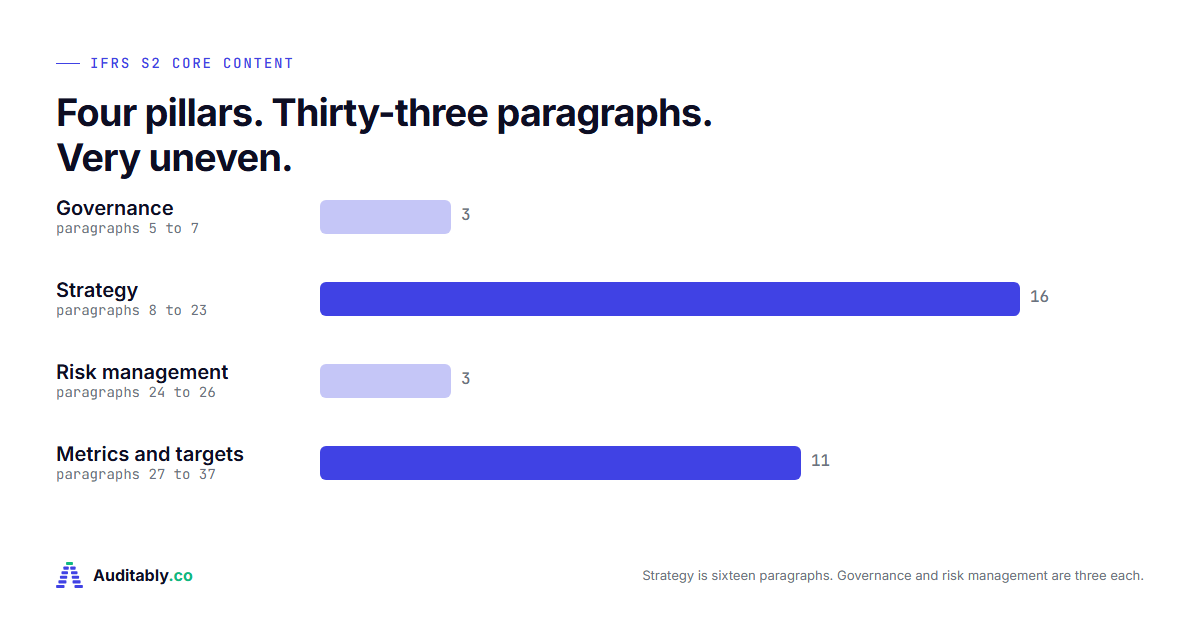
The core content is shorter than people expect. Thirty-three paragraphs, paragraph 5 through paragraph 37, split into four pillars of very uneven size.
Scroll the table sideways on a phone →
| Pillar | Paragraphs | What it asks for |
|---|---|---|
| Governance | 5 to 7 | Who oversees climate risk, and five specific questions about them: terms of reference, how skills were assessed, how and how often they are informed, how climate features in strategy oversight, and whether it reaches remuneration. |
| Strategy | 8 to 23 | The largest pillar. Your risks and opportunities, the time horizons you use, effects on your business model and value chain, effects on your financial position, your transition plan if you have one, and your climate resilience assessed through scenario analysis. |
| Risk management | 24 to 26 | How you identify, assess, prioritise and monitor climate risk, and how far that is integrated into the risk management you already run. |
| Metrics and targets | 27 to 37 | Greenhouse gas emissions, the other cross-industry metric categories, industry-based metrics, and eight required elements for every target you disclose. |
Strategy is sixteen paragraphs and metrics and targets is eleven. Governance and risk management are three each. That ratio is worth knowing before you plan the work, because it tells you where the drafting time goes.
The part finance teams underestimate
Most of the standard asks for a number or a description. A smaller part asks you to explain a judgement, and that is where first cycles come unstuck.
Paragraph 22 is the clearest example. It asks you to assess climate resilience using scenario analysis, with an approach commensurate with your circumstances. Commensurate is not a licence to keep it light. It is a judgement measured against your own exposure and the skills, capabilities and resources available to you. A smaller team can reasonably land on a qualitative approach. What it cannot do is skip the assessment that led there, because the assessment is the thing you would be asked to produce.
The same shape appears in paragraph 6 on governance. Saying the board oversees climate risk satisfies nothing. The paragraph asks five questions about that body, and each answer is a document you either have or do not: a terms of reference that mentions climate, a record of how competence was determined, a meeting schedule, minutes, and a remuneration decision.
What it says about numbers you cannot produce
This is the most useful thing to understand early, and the most frequently missed. The standards contain defined ways to say not yet.
On the financial effects of climate risk, IFRS S1 sets out when you need not give quantitative information: where the effects are not separately identifiable, or the measurement uncertainty is so high the number would not be useful, or you do not have the skills, capabilities or resources to produce it. In each case you explain why you have not quantified it.
There are also first-period transition reliefs. You can report climate only in your first annual reporting period and leave the wider sustainability topics until the second. You need not give comparatives in that first period. Scope 3 can wait a period. You can keep a measurement method you already use. And the disclosures can be published after the financial statements rather than alongside them.
Using a relief properly, and saying which one you used, is a finished disclosure. Going quiet about a gap is not. That distinction is worth more to a first-cycle team than any amount of measurement work.
The emissions requirements, briefly
Scope 1 and Scope 2 are your own operations and your purchased energy. Scope 3 is everything else in your value chain, split into fifteen categories by the GHG Protocol.
One detail catches people out. For Scope 2, paragraph 29(a)(v) requires the location-based figure. The market-based figure, the one that reflects your renewable contracts, is additional information you may give. It is not an alternative to the location-based number, and a lot of first-cycle reports present it as though it were.
Measurement follows the GHG Protocol Corporate Standard unless a jurisdictional authority or your exchange requires a different method. Gases are converted using 100-year global warming potential values from the latest IPCC assessment available at your reporting date, subject to the same kind of jurisdictional carve-out.
What changed in December 2025
The ISSB issued four targeted amendments to the emissions requirements, effective for annual reporting periods beginning on or after 1 January 2027, with early application permitted.
In short: you may limit Category 15 to financed emissions only; you may use a classification system other than GICS to disaggregate financed emissions; and there is jurisdictional relief on both the GHG Protocol method and the GWP values.
Each one is a relief that leaves an explanation behind. If you limit Category 15, you explain what you treated as a derivative and describe the activities you excluded, and if Category 15 sits inside your Scope 3 figure you disclose the total with the financed emissions subtotal inside it. Less measurement, more explanation of why you measured less.
What a finance team actually has to produce
Strip away the framework language and a first cycle comes down to a short list.
- A named body with oversight, and the documents behind the five questions in paragraph 6.
- Time horizons with stated boundaries, and the reason those boundaries were chosen.
- Emissions figures with the source data, the method, the factor version, and a review by somebody who did not prepare them.
- Targets with the eight elements paragraph 33 requires for each one.
- A record of which reliefs you relied on and when you decided.
- A scenario analysis, plus the assessment that explains why that approach was proportionate.
None of that is difficult on the day it happens. Almost all of it is close to impossible to reconstruct a year later, which is when an assurance provider asks.
Common questions
Is IFRS S2 mandatory?
Not by itself. The ISSB writes the standard and individual jurisdictions decide whether to adopt it, for whom, and from when. More than twenty jurisdictions have adopted or committed to adopting the ISSB standards, on timelines that differ considerably. Whether it applies to you is a question about your regulator, not about the standard.
What is the difference between IFRS S1 and IFRS S2?
IFRS S1 sets the general requirements for sustainability-related financial disclosure. IFRS S2 covers climate specifically. IFRS S1 carries the general machinery, including the materiality judgement and the provisions on when you need not quantify financial effects. Most first cycles apply both, and many use the first-period relief to report climate only.
Does IFRS S2 require Scope 3 emissions?
Yes, with a first-period relief that lets you defer them. Scope 3 is disclosed by GHG Protocol category, and you state which categories are included. The December 2025 amendments also allow an entity to limit Category 15 to financed emissions.
Do I need assurance over IFRS S2 disclosures?
That depends on your jurisdiction. Several regimes phase assurance in, usually starting with limited assurance over emissions. Limited assurance concludes in the negative form, meaning nothing came to the practitioner attention suggesting material misstatement. Reasonable assurance is a positive conclusion and tests the controls that produced the figure, which is a different level of preparation.
How long does a first IFRS S2 cycle take?
Longer than the reporting month, because several disclosures describe things that had to happen during the year. You cannot write that the board was informed quarterly if the meetings did not occur, and you cannot evidence a competence assessment nobody performed. The drafting is the last stretch. The evidence is created across the whole year.