The ISSB does not make anyone report. It writes the standard, and then each jurisdiction decides whether to adopt it, for whom, and from when. So the question is never whether IFRS S2 applies in the abstract. It is what your regulator has done with it.
Key points
- IFRS S2 has no legal force on its own. Adoption is a jurisdictional decision.
- Most regimes phase in by size, listing status or both, starting with the largest listed entities.
- If you operate in several markets you may be in scope in one and out in another, on different timelines and against slightly different local standards.
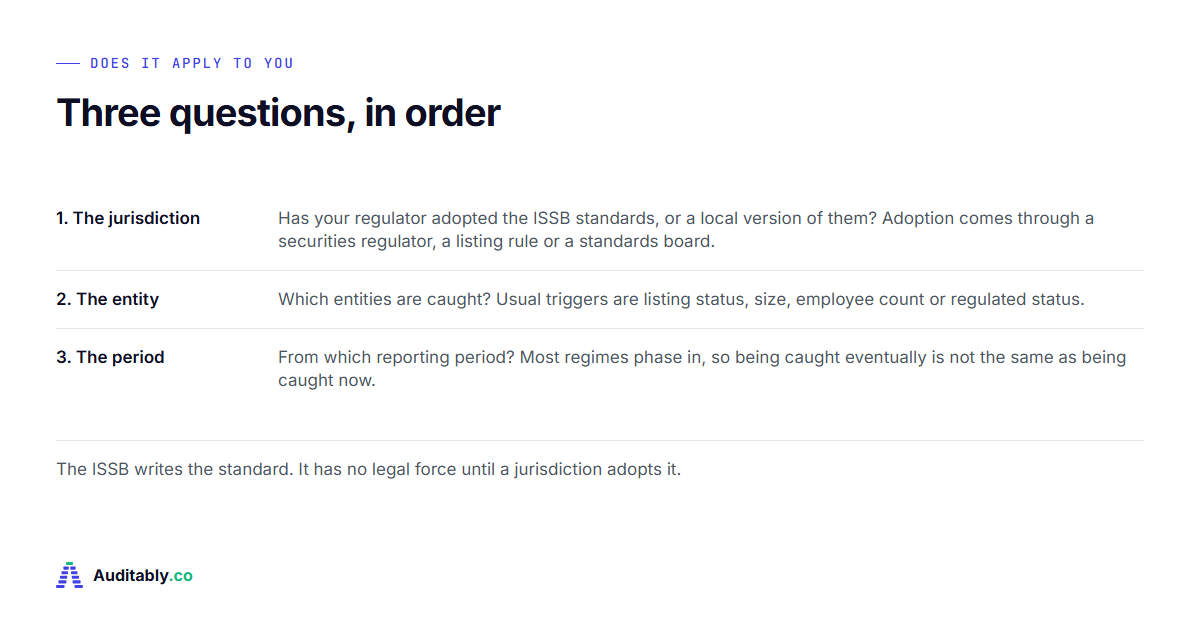
The three questions that decide it
Work through these in order. Each one narrows the answer, and the output of all three is the memo you should keep on file.
- Has my jurisdiction adopted the ISSB standards, or its own version of them? Adoption is usually through a securities regulator, a listing rule or an accounting standards board.
- If so, which entities are caught, and am I one of them? The usual triggers are listing status, market capitalisation, revenue, employee count or regulated status.
- From which reporting period? Most regimes phase in over several years, so being in scope eventually is not the same as being in scope now.
The usual scope triggers
Scroll the table sideways on a phone →
| Trigger | What it usually means |
|---|---|
| Listing status | The most common first wave. Listed entities on the main board, often with a size threshold on top. |
| Size | Market capitalisation, revenue or total assets above a stated figure. Phased regimes typically lower the threshold in later groups. |
| Employee count | Common in European-style regimes, less so in ISSB adoptions. |
| Regulated status | Banks, insurers and asset managers are frequently brought in early and separately, because their financed emissions matter to system-wide risk. |
| Public interest | Some regimes catch large unlisted entities on a public-interest test rather than a listing. |
Two details catch groups out. First, the test usually applies at the level of the reporting entity, so a subsidiary of a caught parent may not itself be caught while still having to supply data upward. Second, thresholds are often tested over a period rather than at a date, so a company that crosses one mid-year may be in scope sooner than it expects.
If you are caught in more than one place
This is the common position for any group with listings or operations across markets, and it is more manageable than it first looks.
The ISSB standards are designed as a global baseline, so most adopting jurisdictions start from the same text and then modify it. The differences that matter in practice are the effective date, the scope threshold, whether assurance is required and at what level, and whether local carve-outs apply to measurement or to GWP values.
The practical approach is to report to the strictest requirement you face and then satisfy the others from the same evidence base. What you should not do is run two disclosure processes, because the second one will be the one with no records behind it.
If you are not caught yet
Two reasons to do some of the work anyway, neither of them about compliance.
The first is that several disclosures describe things that must happen during a reporting year. Board oversight, a competence assessment, a scenario analysis and a target-setting discussion are contemporaneous facts. If your first mandatory period is FY2027, the evidence for that period is created during FY2027, which means the process has to exist before it starts.
The second is that you are probably already being asked. Customers in scope need your emissions for their Category 1, lenders ask for it against their Category 15, and both will ask how the number was derived. Those requests arrive well before your own regulator does.
How adopting regimes tend to differ
Most jurisdictions start from the ISSB text and then modify it. Five differences account for almost all of the practical variation, and these are the ones to check rather than reading each local standard end to end.
Scroll the table sideways on a phone →
| What varies | What to check |
|---|---|
| Effective date and phasing | Which group you fall into and the first period that group reports for. Phased regimes commonly run three or four waves over several years. |
| Scope threshold | Whether it is listing status, market capitalisation, revenue, assets, employees or a combination, and whether it is tested at a date or over a period. |
| Assurance | Whether it is required, at what level, over which information, and from when. Assurance is frequently phased separately from the disclosure itself. |
| Local carve-outs | Whether the jurisdiction requires a measurement method other than the GHG Protocol, or GWP values other than the latest IPCC assessment. |
| Relief availability | Whether the local regime preserves the transition reliefs in full, narrows them, or adds its own. |
The last two are the ones people miss, because they sit in the local instrument rather than in IFRS S2 itself. A jurisdictional requirement to use a particular measurement method changes what you actually calculate, and the standard now accommodates that explicitly.
The year before your first mandatory period
If you know your first reporting period, the work starts before it does. Several disclosures describe events, and events cannot be created retrospectively.
- Amend the terms of reference of whichever body will hold oversight, so climate is written into them before the period begins
- Perform and minute a competence assessment of that body
- Fix the reporting frequency and put the meetings in the calendar
- Decide whether climate metrics enter remuneration, and record the decision either way
- Run a screening estimate across the Scope 3 categories so you know which ones will matter
- Identify the owner of each emissions figure and the second person who will review it
- Decide which transition reliefs you intend to use, and write down why
That list costs a few days spread across a quarter. The same list attempted in the reporting month produces a disclosure describing things that did not happen, which is the one outcome worth avoiding.
The supply chain question
Most companies encounter IFRS S2 through a customer rather than a regulator, and that request has a different shape.
A customer in scope needs your emissions for their Category 1, purchased goods and services. A lender needs it for their Category 15. Neither is asking for a compliant IFRS S2 disclosure. They are asking for a number they can defend inside their own, which means they will ask how it was derived, what it covers and who checked it.
This is worth treating as the same work rather than a separate exercise. The evidence that satisfies a customer questionnaire is the evidence that satisfies your own first cycle, and building it once is considerably cheaper than building it twice.
What to put in the scoping memo
- The regime that applies, and the instrument that imposes it
- The test that brings you into scope, and the figures you measured against it
- Your first mandatory reporting period, and the date you concluded that
- Which entities in the group are inside the reporting boundary
- Whether that boundary matches your financial consolidation, and if not, why
- Which transition reliefs you intend to rely on
- Who approved the conclusion, and when
This is a one-page document and it is the first thing anyone reviewing your first cycle will ask for. It is also the thing most often reconstructed from memory eleven months later.
Common questions
Is IFRS S2 mandatory?
Only where a jurisdiction has adopted it. The ISSB issues the standard and individual regulators decide whether it applies, to whom and from when. More than twenty jurisdictions have adopted or committed to adopting the ISSB standards, with effective dates spread across several years.
Does IFRS S2 apply to private companies?
In most adopting regimes the first waves are listed entities, so private companies are usually outside the initial scope. Some regimes catch large unlisted entities on a public-interest or size test. Private companies in the supply chain of a caught entity are often asked for emissions data regardless of their own obligation.
Does IFRS S2 apply to subsidiaries?
The requirement normally attaches to the reporting entity. A subsidiary of a caught parent may have no obligation of its own while still needing to produce data to the parent, on the parent timetable and to the parent evidence standard.
What if my jurisdiction has not adopted IFRS S2?
You have no obligation, and you may still have a requirement in practice. Customers and lenders that are in scope need your figures for their own Scope 3 and financed emissions, and they will ask how the number was produced. Building the record early costs little and answers both.