Materiality is the decision that shapes every other decision in the report. It also produces the question a reviewer asks first, which is not what did you conclude but how did you conclude it.
Key points
- IFRS S2 uses single materiality: information matters if it could reasonably be expected to affect investor decisions.
- That is a narrower test than the double materiality used in the European regime, and it produces a different list of topics.
- The judgement has to be recorded when it is made. Reconstructing it afterwards is the thing that gets noticed.
The test IFRS S2 actually applies
Information is material if omitting, misstating or obscuring it could reasonably be expected to influence the decisions that primary users of general purpose financial reports make on the basis of those reports. Primary users means existing and potential investors, lenders and other creditors.
That is the same definition financial reporting already uses, applied to climate information. Which is the point. The ISSB deliberately anchored sustainability materiality to the concept your finance function already operates, rather than inventing a parallel one.
The practical consequence is that the question is always about enterprise value. Does this climate matter affect the entity prospects in a way an investor would want to know about? If yes, it is in scope, whatever its wider significance.
Single versus double materiality
This is the most common point of confusion for anyone who has read about the European regime, and the difference is real.
Scroll the table sideways on a phone →
| IFRS S2, single materiality | European regime, double materiality |
|---|---|
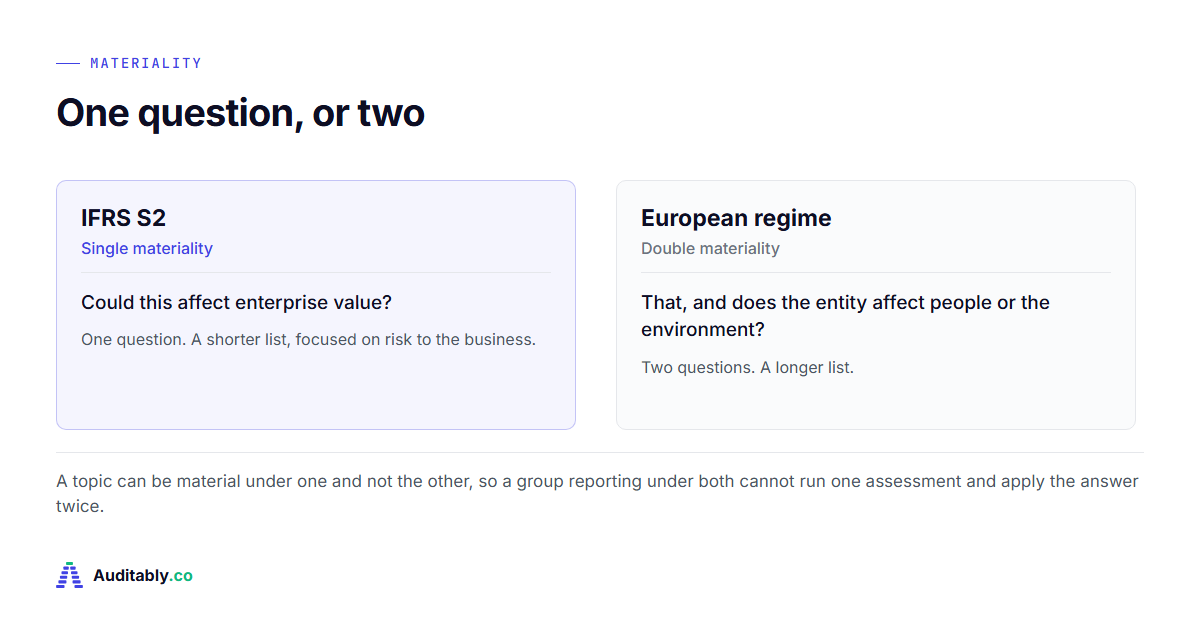
| One question: could this affect enterprise value? | Two questions: could this affect enterprise value, and does the entity affect people or the environment? |
| A topic is in scope if it is financially material. | A topic is in scope if it is financially material OR has material impacts outward. |
| Produces a shorter list, focused on risk to the business. | Produces a longer list, including impacts that may never affect the business financially. |
Neither is more rigorous than the other. They answer different questions for different readers. What matters practically is that a topic can be material under one and not the other, so a group reporting under both cannot run a single assessment and apply the result twice.
Where the judgement actually gets made
Materiality is not one decision at the start of the cycle. It shows up in at least four places, and each needs its own reasoning.
- Which climate risks and opportunities you identify and disclose at all.
- Which Scope 3 categories are included in your emissions figure, and which are left out.
- Which industry-based metrics you disclose, having referred to and considered the applicable guidance under paragraph 32.
- Whether a financial effect is significant enough to describe, and whether it can be quantified.
The Scope 3 one causes the most trouble. A list of included categories with no explanation of the absent ones invites a reader to assume the omission was an oversight rather than a conclusion. The fix is a screening estimate, written down: rough out every category, rank them, and record why the small ones were excluded.
Materiality is not a licence to say less
Two things in the standards cut against using materiality as a reason for silence.
The first is that several disclosures are required either way. Whether you use an internal carbon price is disclosed whichever the answer is. Whether climate performance sits in remuneration is disclosed whichever the answer is. Concluding that something is not material to you does not remove the requirement to say so.
The second is that where you cannot give a number, the standards ask for an explanation rather than an omission. On the financial effects of climate risk, IFRS S1 sets out the circumstances in which quantitative information need not be provided, including where the effects are not separately identifiable, where measurement uncertainty is so high the figure would not be useful, and where you do not have the skills, capabilities or resources. In each case the requirement is to explain why.
A worked assessment, start to finish
A mid-size manufacturer with operations in two countries. This is the shape of an assessment that holds up, and it is shorter than most people expect.
Scroll the table sideways on a phone →
| Stage | What was done | What was recorded |
|---|---|---|
| Identify | Listed the climate matters plausibly relevant: physical risk at two coastal sites, carbon pricing exposure, customer requirements, energy cost volatility, technology shift in a product line | The list, including items considered and set aside |
| Assess | For each, asked whether it could reasonably be expected to affect enterprise value over the stated horizons | The reasoning per item, and the information it rested on |
| Conclude | Four matters in, one out. The technology shift was judged not to affect enterprise value within the long-term horizon | The conclusion and the reason for the exclusion |
| Approve | Reviewed by finance, approved through the governance route described in the paragraph 6 disclosure | Who approved it and when |
The item that was excluded is the most valuable line in that record. A materiality assessment that lists only what was included tells a reader nothing about how the boundary was drawn.
Where materiality and the evidence trail meet
A materiality conclusion is a judgement, and judgements are the part of a disclosure that cannot be reconstructed. A number can be recalculated from source data at any point. The reasoning that led you to include one topic and exclude another exists only if somebody wrote it down at the time.
That is the practical reason to treat the assessment as a working paper rather than a slide. Eight months later, a conclusion with no reasoning behind it looks like a preference. The same conclusion with a dated record of what was considered, what it rested on and who approved it looks like what it is.
What a reviewer asks about materiality
- What did you consider and reject, and why
- What threshold or test did you apply
- What information did the judgement rest on
- Who made it, and who approved it
- Has anything changed since last year, and did the conclusion change with it
- How did you conclude the excluded Scope 3 categories were immaterial
The last one comes up more than any of the others, because Scope 3 is where a materiality judgement has the largest effect on the reported number.
Recording the judgement so it survives
Everything above produces the same practical instruction. Write down the reasoning at the point the decision is made.
- What was considered, including the topics you looked at and rejected
- The threshold or test you applied, in whatever terms you actually used
- The information the decision rested on
- Who made the judgement, and when
- What would change the answer, so next year starts from something
Eight months later, a materiality conclusion with no reasoning behind it looks like a preference rather than a judgement. That distinction is the difference between a defensible disclosure and an awkward meeting.
Common questions
Does IFRS S2 use double materiality?
No. IFRS S2 applies single, investor-focused materiality. Information is material if omitting or misstating it could reasonably be expected to influence the decisions of primary users of general purpose financial reports. The double materiality approach, which also asks about outward impact on people and the environment, belongs to the European regime.
Can a topic be material under CSRD but not IFRS S2?
Yes, and that is the normal case rather than an edge case. A topic with significant outward impact but no foreseeable effect on enterprise value can be material under a double materiality test and not under a single one. A group reporting under both needs one assessment that answers both questions rather than one answer applied twice.
Who decides what is material?
Management makes the judgement and should be able to show how. In practice the decision is usually proposed by the reporting team, reviewed by finance and approved through the governance route described in your paragraph 6 disclosure. That approval is worth recording, because it is the step most often missing.
What if we are not sure whether something is material?
Record the uncertainty rather than resolving it silently in either direction. A disclosure that describes a topic and explains why the effects could not be quantified is complete. A topic dropped with no note reads as an omission, and the reader cannot tell which it was.