Most first-cycle plans are built backwards from the publication date. That is the wrong shape, because several IFRS S2 disclosures describe things that had to happen earlier in the year. You cannot write that the board was informed quarterly if the meetings did not occur.
Key points
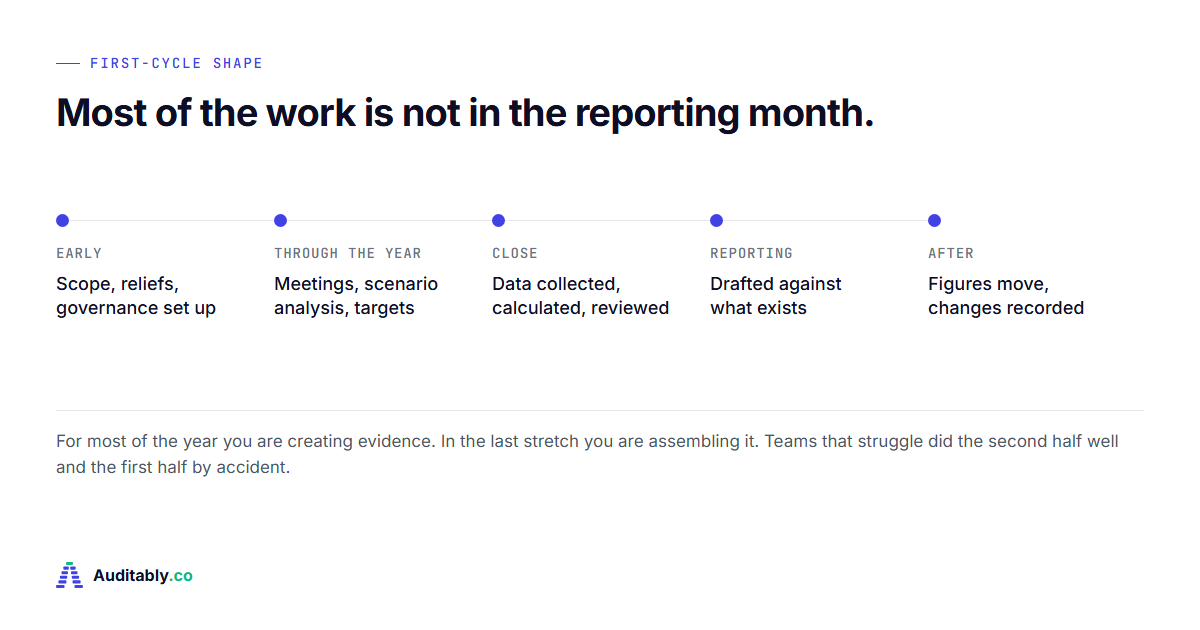
- The cycle splits into two halves that feel unrelated. For most of the year you are creating evidence. In the last stretch you are assembling it.
- Governance, scenario analysis and target-setting are contemporaneous facts. They exist or they do not.
- Teams that struggle usually did the second half well and the first half by accident.
Step 1: establish scope and applicability
Before anything else, settle three questions in writing. Which regime applies to you and from when. Which entities are inside the reporting boundary, and whether that matches your financial consolidation. And which transition reliefs you intend to rely on.
That last one shapes the whole plan. If you take the climate-first relief and defer Scope 3, your first cycle is a materially smaller piece of work than if you do not. Decide it early and record the decision, because next year somebody will ask which reliefs applied and the answer needs to be a record rather than a recollection.
Step 2: set up governance before you need to describe it
Paragraph 6 asks five questions about your oversight body, and every one of them is answered by a document rather than a sentence.
- Amend the terms of reference so climate oversight is written into them
- Perform and minute a competence assessment, rather than asserting the board is appropriately skilled
- Fix the reporting frequency and put it in the calendar
- Make sure climate appears in the minutes when strategy and major transactions are discussed
- Decide whether climate metrics enter remuneration, and record the decision either way
All five are cheap in month one and impossible in month eleven. This is the single highest-return week in the whole cycle.
Step 3: build the emissions data process
Work out where each figure comes from before you calculate anything. For every emissions number, name the source system or document, the person who owns it, the factor set you will apply, and who reviews the result.
Two process decisions are worth making now rather than later. The reviewer must not be the preparer, and the approval has to be recorded at the time with a date. Neither requires a system. A dated line in a controlled document does it. What it requires is deciding, before the cycle, who carries each figure.
Also decide what happens when a figure moves after approval, because it will. A supplier reissues an invoice, a meter read is corrected, and the number you approved in September is wrong by March. The controlled answer is to record the reason, the old value, the new value, the evidence and the person, and to re-approve. The uncontrolled answer is to overwrite the cell, which leaves you with a disclosure that is accurate and undefendable at the same time.
Step 4: do the scenario analysis, and record why
Paragraph 22 asks you to assess climate resilience using scenario analysis, with an approach commensurate with your circumstances. Assessing those circumstances includes your exposure and the skills, capabilities and resources available to you.
The work has three stages and each one leaves something behind. Assess your circumstances, and record the exposure and the capability you have. Determine an approach, and record what you chose and what you ruled out. Carry out the analysis, and record the inputs, the assumptions and when it was done.
A qualitative approach is allowed. An undocumented one is not. The trap is that proportionality feels light while you are inside it and reads as an unexplained shortcut afterwards, when the person who made the judgement has moved on and the file records only the conclusion.
Step 5: set targets properly the first time
If you are going to disclose a target, paragraph 33 wants eight things for each one: the metric, the objective, the part of the entity it applies to, the period it runs over, the base period, any milestones, whether it is absolute or intensity, and how the latest international agreement on climate change informed it.
The last of those is the one that gets skipped, because nobody was asked to write it down in the meeting where the target was approved. It is a two-sentence answer if you capture it at the time and an awkward reconstruction if you do not.
Step 6: assemble, review and publish
Now the drafting. By this point the disclosures should be describing things that already exist, which is a very different exercise from writing sentences and hoping the evidence turns up.
Before it goes out, read your own narrative the way a reviewer will. The pen does not go to the emissions figures, which are prominent and checkable. It goes to the connecting sentences written late by whoever was finishing the section. Regularly reviews is a frequency. Considers its approach appropriate means somebody assessed it. Integrated into existing processes means there is a process to point at. Each is a factual assertion, and each is easy to support if the underlying thing happened.
Who does what
A first cycle fails on ownership more often than on technical difficulty. Naming the owner of each piece at the start removes most of the friction.
Scroll the table sideways on a phone →
| Piece | Usually owned by | The failure mode |
|---|---|---|
| Scoping and reliefs | Group reporting or the controller | Never written down, so next year nobody can say which reliefs applied |
| Governance evidence | Company secretary, with the committee chair | Treated as a reporting task in month eleven rather than a calendar item in month one |
| Emissions data | Sustainability, with a finance reviewer | Prepared and reviewed by the same person, which is not a review |
| Scenario analysis | Risk, or an external adviser | The conclusion survives; the reasoning that justified the approach does not |
| Targets | Whoever proposed them, usually strategy or sustainability | Approved in a meeting that captured the decision and not the basis for it |
| The narrative | Whoever is finishing the section | Assertions written late, with nobody assigned to support them |
The last row is worth dwelling on. The connecting sentences in a climate disclosure are typically written by the person closing the document, under time pressure, and they are the sentences most likely to assert something nobody can evidence.
The failure modes, in the order they appear
Four recur, and each has a cheap preventative if you know about it in advance.
Scroll the table sideways on a phone →
| Failure | When it appears | The preventative |
|---|---|---|
| Retrospective governance | Drafting, when somebody writes that the board was informed quarterly | Fix the meeting calendar in month one and keep the minutes |
| The unreviewable figure | Review, when the preparer is the only person who understands the working | Name a second person per figure at the start, and have them sign with a date |
| The undocumented judgement | Assurance, when the scenario or materiality reasoning cannot be produced | Write the reasoning into the working file at the moment of the decision |
| The silent correction | After publication, when a figure moves and the prior value disappears | Record reason, old value, new value, evidence and person, then re-approve |
What to have ready before the first review meeting
If an assurance provider or an audit committee is going to look at the first cycle, these are the six artefacts they will ask for. Having them assembled shortens the conversation considerably.
- The scoping memo: regime, test, first period, boundary, reliefs, approver
- The governance pack: amended terms of reference, competence minute, meeting schedule
- The emissions file: source documents, factor register, calculations, dated reviews
- The scenario working file: circumstances assessed, approach chosen, inputs and assumptions
- The target record: the eight elements per target, and the basis captured at approval
- The change log: anything that moved after first approval, with the reason
None of the six is a large document. All six are close to impossible to assemble retrospectively, which is the entire argument for building them as you go.
The calendar, in one table
Scroll the table sideways on a phone →
| When | What happens | What it leaves behind |
|---|---|---|
| Early in the year | Scope decided, reliefs chosen, governance set up | A scoping memo, amended terms of reference, a competence assessment |
| Through the year | Board and committee meetings occur; scenario analysis carried out; targets set | Minutes, the scenario working file, the target approval record |
| Close | Emissions data collected, calculated and reviewed | Source documents, calculations, a dated review by a second person |
| Reporting | Disclosures drafted against what exists | The report, and a mapping from each disclosure to its evidence |
| After | Figures move and are corrected | A change record showing the old value, the reason and the re-approval |
Common questions
How long does IFRS S2 implementation take?
Plan on a full reporting year, not a reporting season. The drafting takes weeks, but several disclosures describe events that have to occur during the year, including board oversight, the scenario analysis and the target-setting discussion. Those cannot be created retrospectively.
Where should a first-cycle team start?
Governance, in the first month. Amending terms of reference, minuting a competence assessment and fixing a reporting frequency are cheap at the start of the year and impossible at the end. They also happen to answer a whole pillar of the standard.
Do we need software for IFRS S2?
Not to comply. A spreadsheet plus a controlled document with dated approvals satisfies the standard. What software changes is how much effort it takes to produce the evidence when somebody asks, and how much of the process survives a person leaving. Decide on the basis of how many entities and figures you are carrying, not on the basis of the standard.
What does an assurance provider look at first?
Usually the narrative rather than the numbers. Phrases asserting that something happens regularly, is appropriate, or is integrated are factual claims, and they are the sentences least likely to have an owner. The emissions figures are prominent and get checked against a working file. The connecting sentences often have nothing behind them.