Governance is the shortest pillar in IFRS S2 and the one most often written as a single sentence. The sentence is usually some version of the board oversees climate-related risks, and it carries far more weight than it can support.
Key points
- Governance is paragraphs 5 to 7. Paragraph 5 states the objective, paragraph 6 is the requirement.
- Paragraph 6 asks you to identify the responsible body and then answer five specific questions about it.
- Read as a preparer, those five questions are a request for five documents.
The structure, briefly
Each pillar of IFRS S2 opens with an objective paragraph and then a requirement paragraph. For governance, paragraph 5 says what the disclosure is for and paragraph 6 says what you must disclose. That ordering matters: satisfying the list in paragraph 6 without achieving the objective in paragraph 5 is not compliance.
Paragraph 6 asks you to identify the governance body or individual responsible for oversight, and then answer five specific questions about them. It also asks about management role in the same processes.
The five questions, and the document each one wants
Scroll the table sideways on a phone →
| The question | The document that answers it |
|---|---|
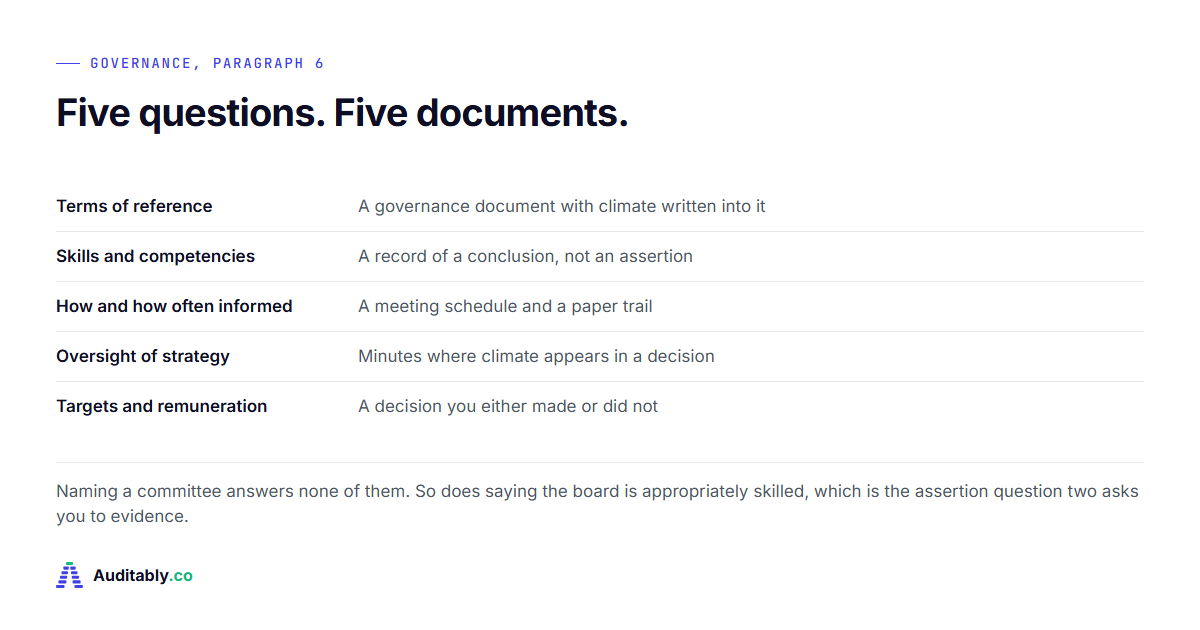
| How oversight responsibilities are reflected in terms of reference, mandates or role descriptions | A governance document with climate written into it. Not a policy statement, the actual constitutional document of the body. |
| How the body determines whether appropriate skills and competencies are available | A record of a conclusion somebody reached, with what it was based on. Not an assertion that the board is appropriately skilled. |
| How and how often the body is informed | A meeting schedule and a paper trail. Regularly is a frequency, and the frequency is the disclosure. |
| How the body takes climate into account when overseeing strategy, major transactions and risk management | Minutes. Specifically, minutes where climate appears in a decision rather than in an update. |
| How it oversees target setting and monitors progress, including whether performance metrics are included in remuneration policies | A remuneration decision you either made or did not. Both answers are disclosable. |
Naming a committee answers none of these. Neither does stating that the board has appropriate expertise, which is the assertion the second question is specifically asking you to evidence.
The two that get missed
Competence and remuneration, consistently.
Competence is usually asserted rather than assessed. The paragraph asks how the body determined that appropriate skills are available, which is a process with an output. A short minute recording that the committee reviewed its own composition against the climate matters on its agenda, identified a gap, and addressed it through training or a new appointment is a complete answer. A sentence saying the board is appropriately skilled is not.
Remuneration is simply a fact. Either climate performance metrics sit in the policy or they do not. Companies sometimes skip the disclosure because the answer is no, but no is a perfectly good disclosure and the absence of any statement is the thing that reads badly.
Why this is cheap early and impossible late
Every one of the five answers is a contemporaneous fact. You cannot write that the body was informed quarterly if the meetings did not occur. You cannot evidence a competence assessment in February that nobody performed. You cannot minute a climate discussion retrospectively.
Which makes governance the highest-return week in a first cycle, if you spend it at the start of the year. Amend the terms of reference, minute a competence assessment, fix the reporting frequency and put it in the calendar, and decide the remuneration question either way. Four actions, none of them expensive, and they answer a whole pillar.
What a complete governance disclosure looks like
Here is the difference between a sentence and a disclosure, on the same facts.
Scroll the table sideways on a phone →
| The version that fails | The version that holds |
|---|---|
| The Board oversees climate-related risks and opportunities. | The Audit and Risk Committee holds delegated oversight of climate-related risks and opportunities. Its terms of reference were amended in March 2026 to include climate explicitly. |
| The Board has appropriate expertise. | The Committee reviewed its composition against the climate matters on its agenda in March 2026, identified a gap in transition-risk experience, and addressed it through a training programme completed in June. |
| Climate is reviewed regularly. | The Committee receives a standing climate item at each of its four scheduled meetings, and received two additional papers during the year on scenario analysis and target setting. |
| Climate is considered in strategy. | Climate was considered in the Committee review of the capital plan in September 2026, specifically in relation to two coastal sites. |
| Not stated. | Climate-related performance metrics are not currently included in executive remuneration policies. |
The right-hand column is not longer because it is padded. It is longer because each line names a thing that happened, and a thing that happened has a document behind it. The left-hand column is shorter because it is describing nothing in particular.
Note the last row. Not currently included is a complete answer. The failure is not the absence of a remuneration link, it is the absence of any statement about it.
Management, and the half of paragraph 6 people forget
Paragraph 6 asks about the governance body and about management role in the same processes. The second half gets far less attention and it is usually easier to answer.
- Which role or committee management uses to assess and manage climate risk
- Whether that role reports to the governance body, and how often
- Whether management uses controls and procedures to support oversight, and how those integrate with other internal functions
For most companies the honest answer involves the reporting or finance function alongside a sustainability lead, which is worth stating plainly. A disclosure that describes a real split of responsibilities is stronger than one implying a dedicated function that does not exist.
The first month of a first cycle
Four actions, none expensive, and between them they answer a whole pillar.
Scroll the table sideways on a phone →
| Action | Time | What it answers |
|---|---|---|
| Amend the terms of reference to include climate | One meeting | The first question |
| Perform and minute a competence assessment | One meeting | The second question |
| Fix the reporting frequency and calendar it | An afternoon | The third question |
| Decide the remuneration question either way | One decision | The fifth question |
The fourth question, how climate features in strategy oversight, answers itself over the year provided the standing item exists. Which is the whole argument for doing this in month one rather than month eleven.
A quick self-test on your current draft
- Is a specific body or role named, or does it say the board
- Is a terms of reference, mandate or role description referenced
- Is a meeting frequency stated as a number rather than as regularly
- Is competence described as a process with an outcome, or asserted
- Is the remuneration link disclosed either way
- Could you produce the document behind each of the five within an hour
The last line is the real test. Everything above can be written. Only some of it can be supported.
Common questions
What does IFRS S2 require for governance?
Paragraph 6 requires you to identify the body or individual responsible for oversight of climate-related risks and opportunities, then disclose how oversight responsibilities are reflected in terms of reference, how the body determines it has appropriate skills, how and how often it is informed, how it takes climate into account in overseeing strategy and major transactions, and how it oversees targets including any remuneration link. Management role in these processes is also disclosed.
Does the board have to oversee climate, or can a committee do it?
Either works. The standard asks you to identify the body or individual responsible, not to place it at a particular level. What it does not accept is ambiguity about who that is. A named committee with a climate mandate in its terms of reference is a stronger disclosure than an unspecified reference to the board.
What counts as evidence of board competence on climate?
A record of an assessment rather than a statement of confidence. A minute showing the body reviewed its composition against the climate matters before it, reached a conclusion, and acted on any gap is what the question is asking for.
Do we have to link executive pay to climate targets?
No. The standard asks you to disclose whether and how climate-related performance metrics are included in remuneration policies. Not including them is a complete answer, provided you say so.