A useful evidence filename identifies the entity or site, the period, the record type and the revision. Keep the pattern short enough to use consistently. The name should help someone locate a record before opening it.
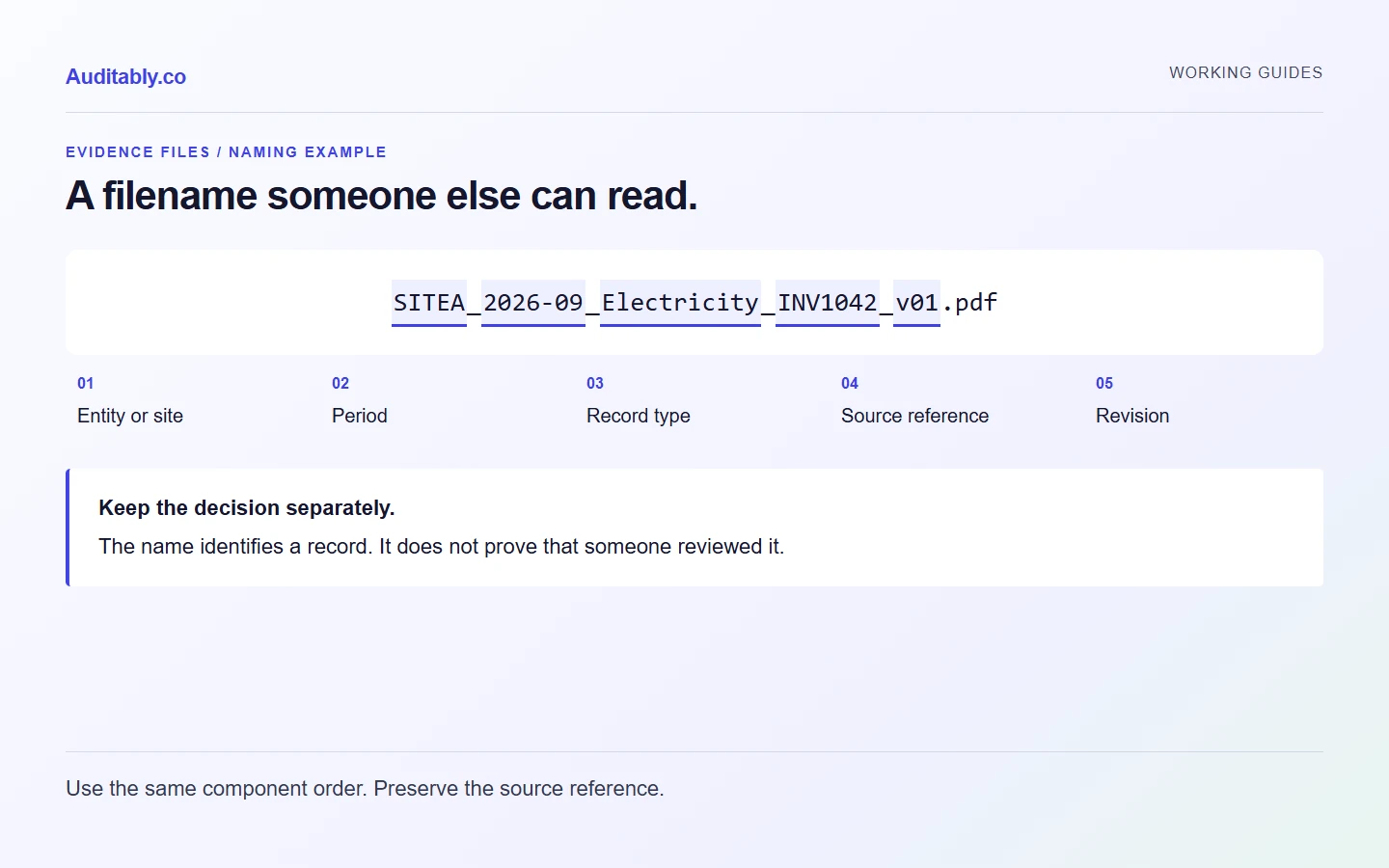
For this guide, we use entity_period_record_reference_revision.ext. The example SITEA_2026-09_Electricity_INV1042_v01.pdf tells a reader more than September final new.pdf. It still needs a retained source, suitable access and a separate review record.
In this guide
Choose a pattern your team can explain
There is no universal filename that every audit requires. Your storage system, record policy and reviewer needs should determine the details. The US National Archives recommends keeping naming components in a consistent order and considering the restrictions of the systems handling the files. See its file-naming guidance.
| Component | Example | Rule for this pattern |
|---|---|---|
| Entity or site | SITEA | Use an agreed code, not a changing nickname |
| Period | 2026-09 | State the reporting period represented |
| Record type | Electricity | Use a small agreed vocabulary |
| Source reference | INV1042 | Preserve the supplier or internal record reference where practical |
| Revision | v01 | Increase when your retained working copy changes |
| Extension | Keep the actual file format |
A period in the filename is a label. Confirm the dates inside the document, especially for bills spanning two months. If an original filename must be preserved, store it in the index rather than losing the connection when a working copy is renamed.
Three examples from one reporting cycle
These names are fictional.
| Record | Suggested name | What the name cannot establish |
|---|---|---|
| Electricity invoice | SITEA_2026-09_Electricity_INV1042_v01.pdf |
Whether the invoice is complete or genuine |
| Allocation workbook | SITEA_2026-09_Allocation_CALC014_v02.xlsx |
Whether the formulas and method were reviewed |
| Review decision | GROUP_2026-Q3_Review_REV031_v01.pdf |
Whether the decision applies to the workbook you are currently viewing |
Connect the three records in an index using stable IDs. Record the version that was reviewed. The link between the decision and the calculation matters more than making each filename extremely long.
Try the filename builder
Enter your agreed codes below. The builder replaces spaces and unsupported punctuation with hyphens and assembles the pattern shown above. It runs in your browser and does not upload or rename any files. Review its output before using it.
Build a filename
No upload or file rename occurs. Use codes your team has agreed.
The builder deliberately accepts a short period label such as 2026-09 or 2026-Q3. It does not decide whether that period accurately describes the source. It also cannot check your organisation's retention or document policy.
Handle replacements without losing the earlier record
If an invoice is corrected, keep the original source and the replacement with their relationship documented. If you revise a calculation, preserve the earlier reviewed copy and record what changed. Do not overwrite an approved file merely because you can reuse its name.
Avoid the label final as your only status control. A file can be final for a preparer and still await review. Put status in the document control register, where it can be connected to the decision and the effective revision.
For shared cloud files, understand whether a link points to a current document or a retained version. The version-history comparison explains the distinction and the questions to test in your own setup.
Agree the folder structure at the same time
A simple structure might group records by reporting cycle, entity and record type. Keep access permissions appropriate to the information inside. Do not place sensitive personal details in filenames that may be visible in search results, shared folders or email subjects.
Write the naming rule in a short note with two or three examples. Ask someone who did not design it to name a sample invoice and find a review record. If they need a long explanation, simplify the convention before rolling it out.
A short handover check
- Can a reader identify the site and period without guessing?
- Does the index distinguish received, reviewed and superseded records?
- Does each review decision identify the record and version it covers?
- Can the intended recipient open the files?
- Are original source names or references preserved where needed?
Download the text checklist beside the builder and use it with your PBC request tracker. Naming makes records easier to find. The supporting index and review evidence make them easier to explain.
Prepared with AI assistance using the linked sources and original worked examples. Illustrative records are fictional. No customer results, independent specialist review or hands-on software testing are claimed.